

 Products & Services








 400 676 5650
Introduction: Mr. Xiaobai, once a staunch "anti-APS advocate," still has numerous comments questioning APS on well-known forums. It wasn't until one day, after losing a bet with a client on whether "APS could be implemented," that he joined ALSI to delve into the mysteries of APS and was ultimately won over. Hence, he wrote this in-depth analysis.
In the digital transformation of manufacturing, MES and APS, as two core tools for production and operations, play a crucial role. However, the topic today is how to choose between the two and align them perfectly with the actual needs of the enterprise.

I. The Golden Age of MES
Looking back to the early 21st century, an era dominated by mass production, MES emerged as a core pillar of information management in discrete manufacturing, finding widespread application in the automotive and medical device industries, playing an indispensable role. Its core purpose was to meet the standardized production requirements set by industry chain leaders, specifically covering dimensions such as traceability, error-proofing, batch management, key component management, and overall quality records. Through this series of refined management and process standardization measures, product quality was ensured and production efficiency improved. In that context of rapid economic growth, production planning and execution were relatively straightforward; simple scheduling and fast execution sufficed to meet the demands of the time.
Henry Ford, the titan of the American automotive industry, famously said, "Quality means doing it right when no one is looking." This implies that to create high-quality products and deliver an excellent user experience, business processes must be finely tuned to ensure every step from production to delivery is precise. Heinrich's famous "Accident Triangle" also emphasized the importance of prevention in production, and MES was the perfect tool born under this guiding principle, the ideal choice for improving production quality and efficiency at the time.

II. From MES to MOM: The Twilight of the Gods
After a period of glory, between 2015 and 2018, MES systems underwent a profound transformation, gradually evolving into the more comprehensive and advanced MOM. This shift was not a "land grab" among vendors but stemmed from the urgent need of manufacturing enterprises to enhance their digital and information capabilities. Compared to earlier MES, MOM was not just a software system but an embodiment of an advanced management philosophy. While encompassing production planning, it also integrated functions like logistics, quality management, and equipment maintenance, significantly enhancing synergy. It once led the industry trend, with its prosperity lasting until 2019.
However, after the peak often comes the prelude to decline. With further digitalization, traditional MOM, due to its inherent limitations and high degree of customization that hindered scalability, gradually lost favor with capital. Simultaneously, as the dividends of the internet faded, a flood of capital poured into the industrial software market, attempting to replicate the glory of the internet industry. The myth of Salesforce made many see opportunities, leading to the insight and study of SaaS, spawning a large number of enterprises centered on lightweight MES and building a new industrial software ecosystem. 2015 is known as the first year of SaaS in China. This wave dealt a massive blow to traditional MOM companies and also marked the advent of the industrial internet bubble era. When one whale falls, everything grows.

III. The Rise of APS: A Stitch in Time
On the same timeline, as the market evolved, some enterprises began reducing product complexity and increasing economies of scale to lower supply chain costs. They adopted an asset-light approach through market mechanisms, focusing on selecting and managing suppliers to improve return on investment. At this point, supply chain planning was needed to align demand and supply, thereby reducing operational costs and improving inventory turnover and on-time delivery rates. Consequently, independent end-to-end APS products, from sales and operations planning to supply chain planning and production scheduling, began to emerge.
In recent years, the market has shifted from a category economy of high-mix, low-volume production to a speed economy driven by flexible supply chains. Consumer influence has increased, and demands for quality and personalization have begun to impact the supply chain, forcing suppliers to pay more attention to supply chain management. APS has gradually moved into the spotlight.
Driven by the times, traditional planning methods have been further fragmented, requiring more granular production planning. APS fills the gap left by MES and ERP in lean decision-making capabilities. Based on established production goals, it provides synchronized decisions on various production resources and supply-demand planning under material and capacity constraints.

IV. MES vs. APS: A Contest of Titans
- Perspective on Production
From the perspective of observing production, MES and APS have fundamental differences.
MES observes production from the angle of production process management and control. Goal: Standardized production, where control points in production are timely and accurately reflected and recorded, meeting requirements for real-time control and post-event query and statistics.
APS observes production from the angle of planning.
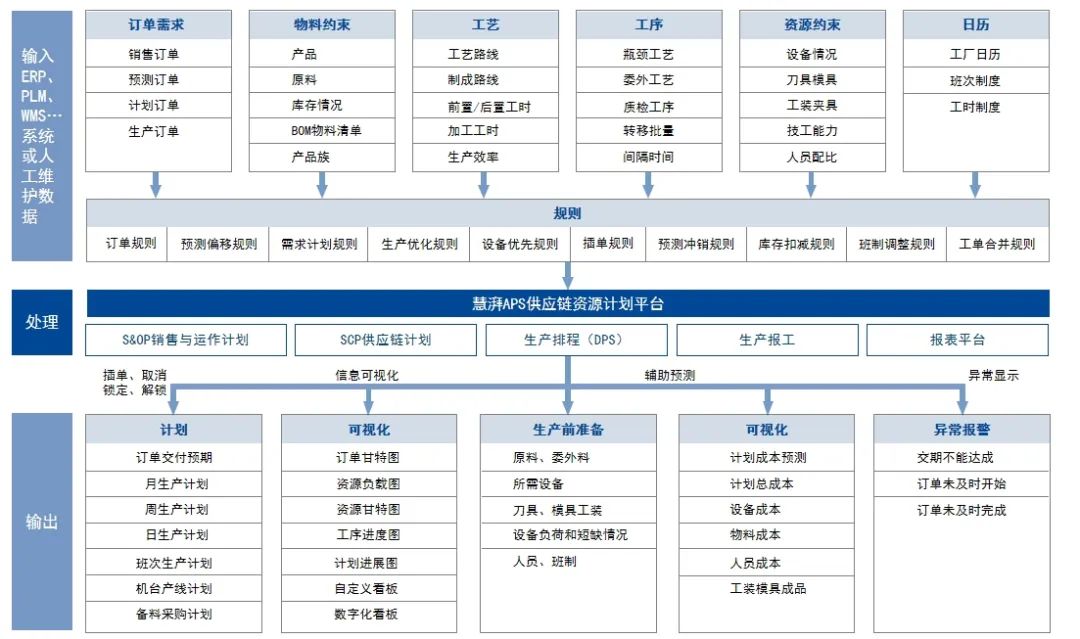
The goal is to ensure the correct start and end times for each process and track progress. APS integrates multi-source data, such as order management, product BOM, and process flows, using advanced algorithms for optimized scheduling to maximize resource utilization and reduce production costs.
- Data Requirements and Focus
In terms of data requirements and focus, MES and APS also differ.
MES needs to integrate a large amount of production data, including equipment status, process parameters, production progress, and quality data. This data is typically collected and updated in real-time to ensure accurate control and management of the production process.
APS primarily relies on production planning data and resource data, such as order data, material data, and production capacity data. It uses advanced algorithms for analysis and optimization to generate the optimal production plan and scheduling solution.
V. APS > MES? Adapting to Circumstances, Each Excels in Its Own Way
- Advanced Planning and Scheduling Capability
The core advantage of APS lies in its advanced planning and scheduling capability. Compared to MES, APS can more comprehensively consider various production resource constraints, such as machine capacity, human resources, and raw material supply, thereby generating more optimized production plans. By deeply mining and analyzing multi-source data, APS can quickly respond to market demand changes and dynamic adjustments in the production environment, achieving refined and intelligent production planning.
- Dynamic Adjustment and Optimization
In terms of dynamic adjustment and optimization of production plans, APS can dynamically adjust production plans based on real-time changes in the production process, such as equipment failures or material shortages, ensuring the continuity and stability of the production line. This flexibility is crucial for handling production anomalies and urgent order insertions, effectively reducing the risk and cost of production interruptions.
- Cost Control and Resource Utilization
In terms of cost control and resource utilization, APS can achieve balanced allocation and efficient execution of production tasks, reducing overtime needs and resource waste. Additionally, based on precise scheduling and long-term production demand forecasts, APS can provide enterprises with scientific equipment investment planning recommendations, further lowering production costs and improving resource utilization.
- Key Customer Needs and Industry Characteristics
For high-mix, low-volume discrete manufacturing enterprises with complex and variable production plans and tight resource allocation—especially those where processes from order receipt to rapid order processing, quick formulation of reasonable production methods, detailed production job planning, and production execution recording and management are relatively simple—APS can use advanced algorithms and optimization techniques to provide the best production plan and scheduling solution, significantly improving production efficiency and resource utilization.
For enterprises that focus on production process transparency and controllability, where production process management, control, and post-event statistical analysis are complex and require recording large amounts of data, but where detailed job planning can be completed by handling just a few simple factors, MES is better suited to meet their needs.

VI. How to Implement Transformation: Step by Step, Steady and Far
The implementation of digital transformation is a perennial issue, one that has existed since the very first day of information systems. We are currently in an era of fast-food culture rife with industry chaos, where various systems, business models, concepts, and definitions emerge endlessly. Informatization, digitalization, AI, the metaverse, and the industrial internet—all seeking to change the industry with an internet mindset—are telling their own stories, dazzling and confusing manufacturing enterprise owners.
Heavy rain does not nourish rootless grass
The top leader of the enterprise must have firm resolve, believe, and take action
The top leader of the enterprise needs unwavering determination, a clear understanding of the difficulties and constraints that may be encountered during the informatization transformation, and the ability to maximize employee initiative, deeply implement the transformation philosophy, and proactively drive project implementation from the top down.
Ask the woodcutter about chopping wood, ask the boatman about sailing
Set clear goals, identify problems, match supply and demand, let professionals do professional work
Management guru Eliyahu Goldratt, in his book "The Goal," proposed that local optima are often a trap and a worthless metric. Therefore, enterprises should not fixate on a single point but should adopt a holistic perspective for overall planning and phased implementation. Clearly define what goals you want to achieve and what problems you need to solve, abandoning the bad habit of "treating the head when the head aches and the foot when the foot hurts." Based on your industry characteristics, seek professional teams, conduct in-depth on-site investigations, identify the real difficulties and breakthroughs, and only then can you achieve efficiency improvements.
For example, in machine-processing-oriented enterprises that pursue OEE indicators, blindly monitoring and managing equipment while ignoring that OEE is directly related to market orders—where order volume determines the OEE value—can lead to problems. If the market demand for orders is not considered, the production department might unscientifically schedule to boost OEE, leading to overproduction, or increase work-in-progress to reduce changeover times, artificially creating a mass production environment that results in inventory buildup. This is a classic case of planning deficiency, requiring a command-and-control system.
Avoid "micromanagement that leads to counterproductive results"
Solve key problems, avoid over-management, do not fight human nature, preserve frontline creativity and the right to self-decision
No matter how excellent the system, its essence is a tool serving "people." After system implementation, management should exercise appropriate restraint, avoiding the system becoming a tool for excessive control. While applying the system, respect, stimulate, and support the initiative and autonomous decision-making ability of frontline employees. Only then can an enterprise achieve long-term prosperity and sustainable, healthy development.
Mr. Xiaobai believes that MES and APS each have their own focus in manufacturing informatization management, together forming the core tools for enterprise production operations. It is recommended that enterprises, when choosing informatization tools, fully consider their actual needs and industry characteristics, selecting the most suitable solution to achieve a dual improvement in production efficiency and competitiveness.