

 Products & Services





 400 676 5650
Difficulty in scheduling is almost a consensus in the machining industry.
From an internal business perspective, production scheduling is increasingly tied to a factory's economic efficiency. The machining industry involves numerous processes, and different parts require different process combinations, meaning production scheduling must precisely consider the process route for each part. Coupled with variable process parameters—different materials, dimensions, and precision levels all require different parameters, such as harder materials needing slower cutting speeds and greater cutting force—production scheduling must account for equipment selection and processing time estimation to maximize capacity utilization, helping factories take on more orders without increasing capacity.
From an external environment perspective, the importance of scheduling becomes even more pronounced. The machining industry is facing increasing uncertainty. On one hand, there are many small-batch, multi-variety, non-standard customized orders, making production scheduling difficult to standardize and delivery dates hard to calculate. If you cater to customers beforehand but fail to deliver afterward, it's better not to take the order at all. On the other hand, order changes are frequent, with many rush orders and order insertions. If you cannot comprehensively assess the impact of inserting an order on existing orders through scheduling and blindly accept orders, it can easily lead to widespread delivery delays. Therefore, without scientific production scheduling, a calm and most economically efficient production process is impossible.
Alongside this importance comes the continuously and exponentially increasing difficulty of scheduling. With the maturity and widespread application of intelligent scheduling systems, the "old" problems that plagued machining factory scheduling now have "new" solutions.
01
Why an "Intelligent Scheduling System"?
In fact, "Intelligent Scheduling System" is not a new term. Especially in the machining and assembly industries, there are many who have tried it and some who have seen initial results. However, for most machining factories, before considering an intelligent scheduling system, they will inevitably first ask these two fundamental questions:
① Why isn't ERP sufficient?
The most fundamental reason lies in the calculation logic of the Material Requirements Planning (MRP) within ERP. Theoretically, factory production aims for material (quantity, time) balance and capacity balance to achieve the most economical output. Material quantity balance can be achieved through MRP, but MRP cannot achieve material time dimension balance or capacity balance. This is because MRP's calculation logic assumes infinite availability of materials and labor, so the scheduling results easily become disconnected from reality, making the plan difficult to implement.
② Why isn't EXCEL sufficient?
Setting aside the fact that manual EXCEL scheduling is inherently reliant on personal experience and is lagging, for the machining industry with frequent outsourcing and demand changes, the most critical issue is that Excel cannot achieve real-time linkage between customer demand, factory production, and supplier supply data, nor can it achieve balance and real-time transparency in terms of time and quantity among these three elements. This consequently affects the accuracy and implementability of the scheduling results.
Of course, in the past era of mass production where everything produced could be sold, ERP and EXCEL were fully capable of meeting factory scheduling needs. However, as mentioned earlier, in the current market environment of personalized customization and intense competition, without a scientific and reasonable production plan, a calm and most economically efficient production process is impossible. Whether large orders can be handled, rush orders can be accepted, each order can be delivered on time, and the production status—all depend on the source: production scheduling.
At this level, the intelligent scheduling system arrives at the right time.
02
What Can an Intelligent Scheduling System Bring to the Machining Industry?
Strictly speaking, an intelligent scheduling system is based on multiple constraint conditions (materials, resources, manpower, etc.), multiple calculation rules (customer importance, required date, etc.), diverse business models, and a powerful algorithm engine. It helps factories transform sales orders into production plans that specify equipment, personnel, materials, and process routes, thereby empowering factories to quickly implement production while globally optimizing production decision-making capabilities.
Specifically, the changes an intelligent scheduling system brings to the machining industry are mainly concentrated in the following three areas:
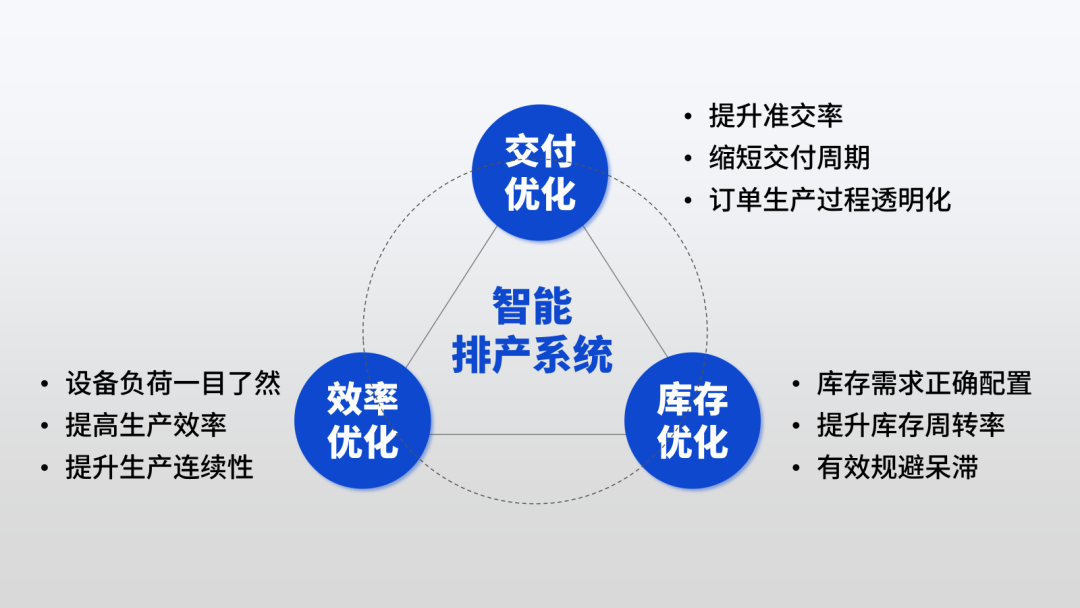
① Delivery Optimization: Improve On-Time Delivery Rate, Shorten Lead Times, Production Transparency
Flexible Scheduling Rules: Relying on powerful algorithmic support, the intelligent scheduling system supports various scheduling rules, such as forward scheduling, backward scheduling, and urgent priority. It can also prioritize the allocation of materials and resources based on different customer requirements and order urgency to respond promptly to customer needs.
Real-time Progress Tracking: Unlike the relatively static management model of EXCEL, the intelligent scheduling system provides more dynamic and real-time control over the entire production plan. The status of each plan, whether it is delayed, and how many days late it is, are all clearly visible, facilitating the timely discovery and intervention of delayed orders to fully ensure delivery.
Quick Adjustment for Rush/Inserted Orders: The intelligent scheduling system can dynamically and instantly respond to rush order insertion requests. The system can automatically calculate the optimal insertion position while providing warnings for affected orders, helping managers comprehensively assess the impact of the inserted order.
② Efficiency Optimization: Profits from Orders Previously Unmanageable
Reduced Changeover/Mold Change Losses: Based on manpower, materials, equipment load, and process routes, the intelligent scheduling system can scientifically calculate the optimal production path. By batching production for the same process, it minimizes mold change and changeover time, thereby increasing capacity.
Real-time Equipment Load Insight: The intelligent scheduling system can intuitively display the current load status of each piece of equipment on the shop floor, enabling managers to better coordinate and plan production. This allows for effective judgment of whether an order can be handled and helps avoid unnecessary investment in equipment capacity.
Fast and Accurate Material Delivery: The intelligent scheduling system pre-establishes the relationship between upstream and downstream processes. Materials can be delivered based on transfer batch sizes or work order quantities, ensuring the continuity of the production process.
③ Inventory Optimization: Reduce Obsolete Stock, Improve Inventory Turnover
Reduced Unnecessary Inventory: Inventory is a result of planning. Many factories use inventory as a buffer in daily production to compensate for efficiency losses (economic batch sizes and capacity balancing) and production delays (advance stocking to improve response speed and sensitivity). Therefore, to get inventory "moving," the first step is to master production planning. The intelligent scheduling system, with its demand-driven scheduling model, effectively reduces inventory obsolescence and improves inventory turnover.
03
How to Select an Intelligent Scheduling System?
Despite the numerous functional benefits of intelligent scheduling systems, there are also many voices saying, "More scheduling system implementations fail than succeed." How to successfully select an intelligent scheduling system that fits one's own factory and can be successfully implemented remains a puzzle for many machining factories. With so many vendors, how do you choose a reliable one?
First, the vendor must have relevant industry experience in manufacturing. Only vendors who have worked in manufacturing and understand the business can identify the real pain points behind your many surface-level problems and help you improve production through the system.
Second, implementation capabilities must be solid. Factory digitalization is 30% system and 70% implementation. This is especially true for intelligent scheduling systems, which heavily test implementation capabilities. Only a professional implementation team can align real factory needs with system functions. Otherwise, an expensive scheduling system can easily become a mere decoration, completely disconnected from actual production.
Third, data must be able to interface with other systems to avoid future duplicate investments.
Fourth, look at case studies, look at case studies, look at case studies. Important things must be said three times.
Our Alps, a 70-year-old traditional manufacturing enterprise, has developed and uses internally the MaiDaFeng Intelligent Scheduling System. With 30 years of practical experience in production scheduling services for machining factories, it can help you truly make the system effective, increasing production and efficiency.
About the MaiDaFeng Intelligent Scheduling System:
MaiDaFeng Intelligent Scheduling System is a production scheduling tool tailored by Alps specifically for small and medium-sized enterprises, characterized by being "small, fast, light, and accurate." The system originates from Alps' self-developed HuiPai APS supply chain resource planning platform, inheriting the core technology of large-scale scheduling systems from Fortune 500 manufacturing enterprises. It retains powerful scheduling capabilities while simplifying complex logic design and data entry, meeting the scheduling needs of small and medium-sized manufacturing enterprises in a more lightweight manner.
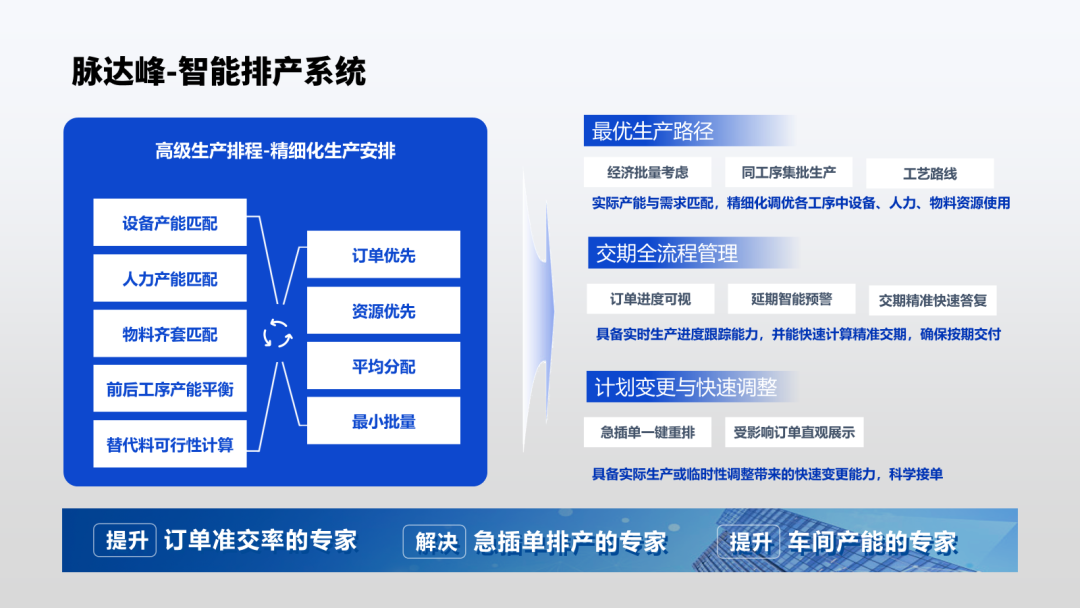
Integrating lean production concepts, the MaiDaFeng Intelligent Scheduling System offers pre-configured solutions for multiple industries, including 3C electronics, mechanical processing, injection molding, PCB processing, and precision electronics. It can integrate key resources such as equipment, personnel, and processes to build an efficient production scheduling management system. The system supports multiple scheduling strategies, displays equipment load and production progress in real-time, and allows for quick schedule adjustments via drag-and-drop operations. It flexibly handles complex scenarios like rush orders and order insertions, ensuring the output of precise production plans for fast and on-time scheduling and delivery date prediction. Material requirements are tightly linked with production plans, with real-time shortage warnings to ensure material availability, improve production efficiency, and reduce inventory pressure. This empowers enterprises to achieve flexible and efficient production management, enabling small and medium-sized factories to increase production efficiency and shorten delivery cycles.