


 Products & Services









 400 676 5650
Time:2026-03-03
In the practical application of APS systems, the furnace-batching algorithm has always been a core and complex critical link.Furnace batching refers to scenarios where multiple production tasks can be processed simultaneously on the same equipment. These tasks start and finish at the same time, forming a pattern of "simultaneous entry and exit."
This scenario is not unique to process industries. In discrete manufacturing, typical examples include annealing in the fastener industry, carburizing heat treatment in the transmission components sector, transformer dipping and drying in the power industry, and aging testing in equipment manufacturing—all classic furnace-batching scenarios.
The core challenge of the furnace-batching algorithm lies in: from a large number of orders, considering constraints such as delivery deadlines, process requirements, and maximum batch capacity, selecting orders that can be combined for batch processing in a furnace, thereby maximizing furnace resource utilization. Compared to general "multi-objective optimization" production scheduling, the furnace-batching algorithm is more akin to "multi-objective optimization within a limited volume," making its computational difficulty evident.
This is precisely why the furnace-batching algorithm is often regarded as a technical challenge in APS systems and even serves as a key criterion for evaluating the technical capabilities of APS vendors.
1. Core Principles of the Furnace-Batching Algorithm
Unlike cyclic tasks (where processing time is linearly related to output) or fixed-cycle tasks (where processing time is constant), the essence of the furnace-batching algorithm is a combination of the "multidimensional knapsack problem" (capacity optimization under multiple constraints) and the "scheduling problem" (time and sequence arrangement).
Taking the fastener industry as an example: annealing is a critical process before cold heading, as it reduces material hardness and improves cutting or cold heading performance. The key question is: which orders can be processed together in the same furnace?
Typically, the APS system first performs a "subtraction" calculation. Based on predefined furnace-batching rules (e.g., material type, process requirements), the system quickly eliminates incompatible combinations. From the feasible solutions identified, heuristic algorithms or genetic algorithms are then applied to find the optimal loading rate scheme according to different optimization objectives.
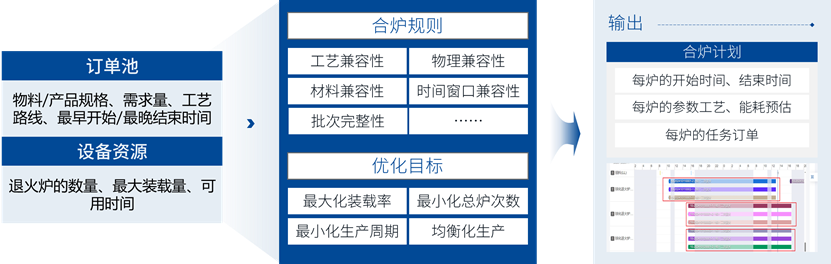
Specifically, the APS system usually builds a multi-dimensional matching model:
Time window matching: Orders must enter the furnace within the time window after the preceding process and before the subsequent process begins.
Capacity matching: Different products vary in volume, weight, and placement; the system must simulate actual furnace space occupancy based on 3D loading rules.
Process parameter consistency: Orders requiring highly compatible temperature curves, holding times, and material characteristics can be processed together.
Material and delivery date clustering: Orders with the same material type are usually processed together, while those with similar delivery dates are prioritized for combination to reduce waiting time in inventory.
In practical operation, the APS system typically uses a rolling scheduling approach. This means that each scheduling run considers not only current pending orders but also reserves some capacity for upcoming urgent orders, achieving a balance between static optimization and dynamic adjustment.
2. Case Study: 20% Efficiency Improvement in Practice
At a leading fastener manufacturing enterprise in Zhejiang Province, the application of the furnace-batching algorithm has brought significant production efficiency improvements.
On one hand, after introducing the HuiFastener APS supply chain resource planning and scheduling platform, the enterprise first optimized the scheduling of bottleneck processes—using cold heading as the anchor, pulling the annealing process forward and pushing subsequent processes backward. The annealing process no longer operates blindly but is precisely scheduled based on actual cold heading demand. This change effectively avoided line-side material buildup, idle or insufficient capacity before heat treatment, providing a stable and continuous task flow for furnace-batching optimization.
On the other hand, combining historical data, process specifications, product dimensions, process requirements, and furnace capacity, the HuiFastener APS system solidified a series of furnace-batching rules. Within these rules, the algorithm searches in real-time for the optimal "material combination" for each furnace, maximizing resource utilization.
To date, the enterprise has seen a roughly 20% improvement in furnace resource utilization. In the annealing process, where energy costs account for a significant portion, every 1% increase in furnace loading rate optimized by the algorithm directly translates into gross margin gains.
Of course, in real-world industrial scenarios, furnace batching takes various forms. Different scenarios involve different constraints, and the algorithm must be adjusted accordingly. Therefore, only APS vendors that truly understand manufacturing needs can convert computational power into actual factory productivity through flexible algorithms. After all, digital transformation should not force enterprises to "cut their feet to fit the shoes" by adapting to software, but rather enable software to better serve the factory.