

 Products & Services







 400 676 5650
The dissemination of lean production has been far from short—spanning twenty, thirty, or even fifty years—yet the market remains rife with varied interpretations. Originating from the Toyota Production System, Toyota defines it as: "A production system built on the philosophy of pursuing the most efficient methods to completely eliminate all waste (the thought of thorough waste elimination, the pursuit of rationality in manufacturing methods, and the systematic integration of this philosophy throughout all production activities)."
The Origins of the Toyota Production System (TPS)
The Toyota Production System (TPS) originated in the 1950s with Taiichi Ohno of Toyota Motor Corporation. He observed that the mass production system designed by Henry Ford effectively minimized the average unit cost of manufactured goods during periods of high growth and high output. However, it lacked the capability to cope with periods of selective low-level growth, such as those following the oil embargo of the mid-1970s. He argued that the waste generated by the mass production system stemmed from its inherent tendency toward overproduction. Theoretically, he posited that anything beyond the minimum quantity of materials, parts, equipment, and workers required to produce a given product constitutes waste and thus increases overall system costs.
The Automotive Industry Action Group defines TPS as: "A rigorous methodology for improving overall productivity and quality by eliminating waste. It dictates the production and delivery of only the necessary high-quality parts, in the right quantities, at the right time and place, while using minimal facilities, equipment, materials, and resources."
TPS employs a combination of several elements. These include smooth production flow, providing flexibility and variety in processes, standardizing work, and utilizing a ordering and delivery system known as Kanban. Leveled production (Heijunka) can achieve TPS by reducing batch sizes through shortened setup times.

The goal of Just-in-Time (JIT) is to produce with only one unit of work-in-process and minimal finished goods inventory. Therefore, unnecessary inventory is waste, and only goods that can be sold should be produced. One-piece flow, where a unit moves just in time to the next process, represents an ideal state! Except in certain processes, no Japanese company has fully achieved this. Nonetheless, this ideal is essential for many Japanese firms, which actively strive to get as close to zero-inventory production as possible.
Toyota's experience shows that when setup times and batch sizes are reduced, significant improvements occur in quality, waste reduction, and worker motivation. It also reduces the need for shelves, warehouses, floor space, forklifts, conveyors, quality control personnel, and support staff.
What is Waste?
In the TPS context, waste is defined as anything beyond the minimum amount of resources absolutely necessary to add value to a product. The key operational phrase thus becomes "value-added." TPS is used to identify non-value-added activities and strive to eliminate them.
The simplest way to identify non-value-added activities is to apply a few discriminators to each step in the process across the factory: Does the activity at each step increase cost without altering the physical or chemical properties of the item? Examples include inspection, material handling, receiving, and business marketing. Does the product stop or pause during transportation? Is the operation performed to rework a product that was not done correctly the first time?
In Japanese companies, quality control is not a separate department or a specialized profession. What the Japanese do is train and equip all personnel—from finished goods to design, and from production to sales—with Total Quality Control (TQC) techniques, transforming the quality control department's concept into company-wide quality control. After thirty years of relentless effort and dedication to improving quality, the Japanese speak of defect rates in parts per million in certain industries, achieving quality levels far exceeding those of Western industry.
TQC is a term commonly used to describe Japanese quality improvement techniques, encompassing some TPS techniques and improving productivity by eliminating waste. In other words, there is overlap between TPS and TQC techniques.
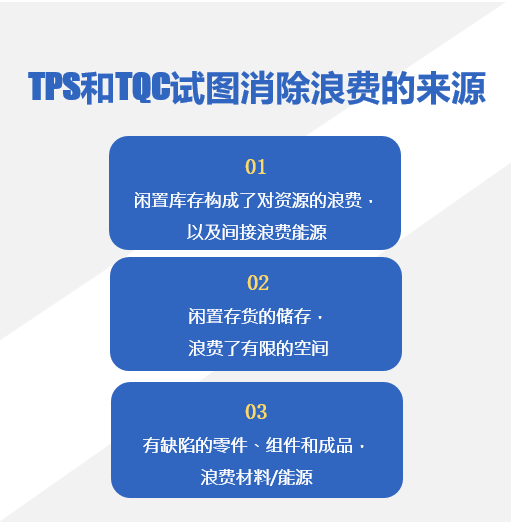
For Japanese factory workers, the goals of TPS and TQC are rational, appropriate, and easily accepted because they aim to eliminate the following sources of waste.
The Kanban System
The Kanban system is a "pull" inventory replenishment system whose fundamental goal is stockless production. Consequently, withdrawal Kanban take precedence over production Kanban. The component control characteristics of Kanban can be enhanced by a technique that boosts productivity: Kanban and component containers are retrieved together, deliberately exposing inconsistencies in output, thereby allowing the root causes of problems to be addressed.
A common misconception is that TPS is an inventory control system. Additionally, TPS is often equated with "Kanban," which is the name of the inventory replenishment information system developed by Toyota Japan. While Kanban is undoubtedly an integral part of TPS production, the Toyota Production System encompasses all production activities, not merely the flow of materials between customers and suppliers.
TPS is also described as a system for improving production efficiency and preventing product defects by reducing inventory. It emphasizes that inventory in a factory is undesirable for more reasons than it is commonly accepted. Inventory hides imbalances between processes and departments: idle time for workers, overstaffing, understaffing, excess capacity, and insufficient maintenance.

The fundamental principles of TPS are evident from the above: a. Identify and eliminate any causes of delay, b. Do not produce unless necessary.
The Multi-Skilled Worker System
Multi-skilled workers are a key factor in process-oriented layout design. The layout or design of a process should ensure that a single worker can operate two or more machines and move from one work center to another. Multi-skilled workers perform maintenance, quality checks, and cleaning tasks, and they also participate in work improvement projects.
The use of multi-skilled workers not only reduces the number of workers and increases productivity but also enhances workers' teamwork and morale. Multi-skilled workers can be considered a special case of job enlargement/enrichment. The Japanese also extensively use Group Technology (GT), which combines multiple processes into cells to simplify product flow.
Although process flexibility might seem synonymous with a lack of standardization, this is not the case in the TPS system. Work standardization is also a hallmark, including standard cycle times, standard routes, and standard quantities in transfer containers. Work standardization leads to more uniform and consistent output rates. This makes it possible to minimize work-in-process inventory, a goal of TPS.
The Role of Employees in TPS Implementation
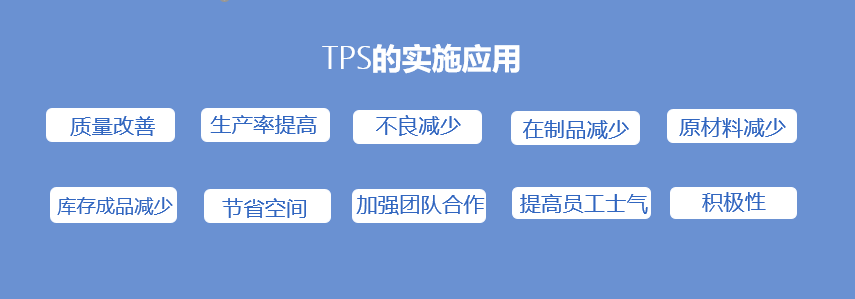
The implementation of TPS involves quality improvement, productivity enhancement, defect reduction, work-in-process reduction, raw material reduction, finished goods inventory reduction, space saving, strengthened teamwork, and improved employee morale and motivation. However, implementing TPS requires substantial cooperation between management and workers.
If a part is defective, workers address it immediately, leading to the factor "increased awareness of problems and their causes." Ideas for controlling product defects are generated by workers, team leaders, engineers, or others who may be called upon to help. This renewed control over defects further strengthens scrap/quality control, with the cycle repeating. It also integrates into the cycle of reducing batch sizes and simplifying production.
The impact of TQC is "reduced rework hours" and "reduced material waste." Additionally, there is a new factor: "higher quality of finished goods." In early descriptions of TPS concepts, improved finished goods quality was not a direct result of TPS. Western industries could achieve equally high product quality through extensive final inspection, rework lines, and scrap bins. Implementing just-in-time does not necessarily improve product quality, but it does reduce costs. In contrast, Total Quality Control definitely improves product quality.
The reason minimal batch sizes lead to reduced scrap and improved quality is simple: if a worker produces only one given part and immediately passes it to the next worker, the first worker will quickly learn if the part does not fit the next station. Defects are detected promptly, and their causes can be nipped in the bud, preventing large-scale production before defects are discovered. Not only can the cause of the problem be addressed immediately, but also the generation of large quantities of defects is prevented.
The ultimate result is that customers receive higher quality goods, possibly at a lower price. When TPS reduces defects and produces more high-quality parts, time and cost spent on rework are reduced. As stated in quality control, "Quality is value added; everything else is waste."
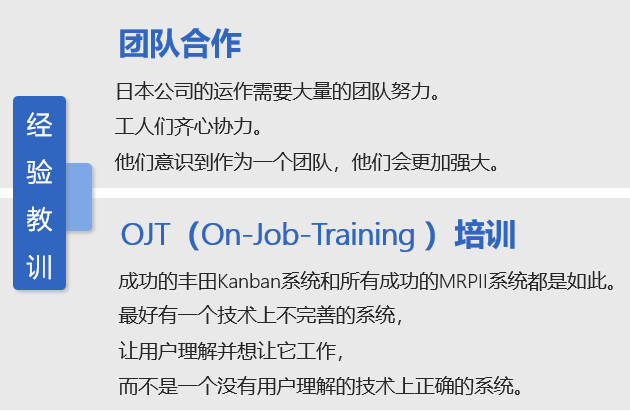
Toyota's success is not merely the result of TPS tools. The key lies in what they did before implementing the system, enabling it to function so effectively.
Many potential users fail to grasp the philosophy and organizational foundation of TPS, despite the surface appearance that TPS is more about quality improvement than solving runaway inventory. The Japanese view the latter as a symptom of manufacturing ills, not a cause, and they reduce inventory to uncover the root causes of failures in the production process.
The Utility of TPS
The TPS enables manufacturing to respond quickly to changes in the mix of products and models sold in the market. This is to give the company flexibility in manpower allocation, allowing the reassignment of employees as necessary to produce the required products and models. This manpower flexibility offers some protection against worker layoffs. That is, when overall demand declines or higher productivity reduces the number of workers needed, they may be reassigned rather than laid off.
Another benefit of TPS is faster response to market demand. By shortening the time from order initiation to completion, the production scheduling system becomes more flexible and more adaptable to changes in workload and demand. Consequently, the business unit can commit to delivery dates more quickly and can change product mix or volume more rapidly, eliminating the need to forecast future orders. By understanding TPS, we can learn valuable lessons.
 Click to view: How to implement information construction for smart factory workshop equipment management?