

 Products & Services






 400 676 5650
Time:2026-02-26
To gain a deep understanding of the APS system, one must first clarify the distinction and relationship between production planning and production scheduling, two key concepts.Production planning focuses on "what to do" and "when to complete it," emphasizing macro-level resource allocation and production goal setting; production scheduling, on the other hand, addresses "where to do it," "who does it," and "in what order," delving deeper into the micro-level fine-tuning of specific operations and resources. The two—one macro, one micro—complement each other and together form the core of production management.
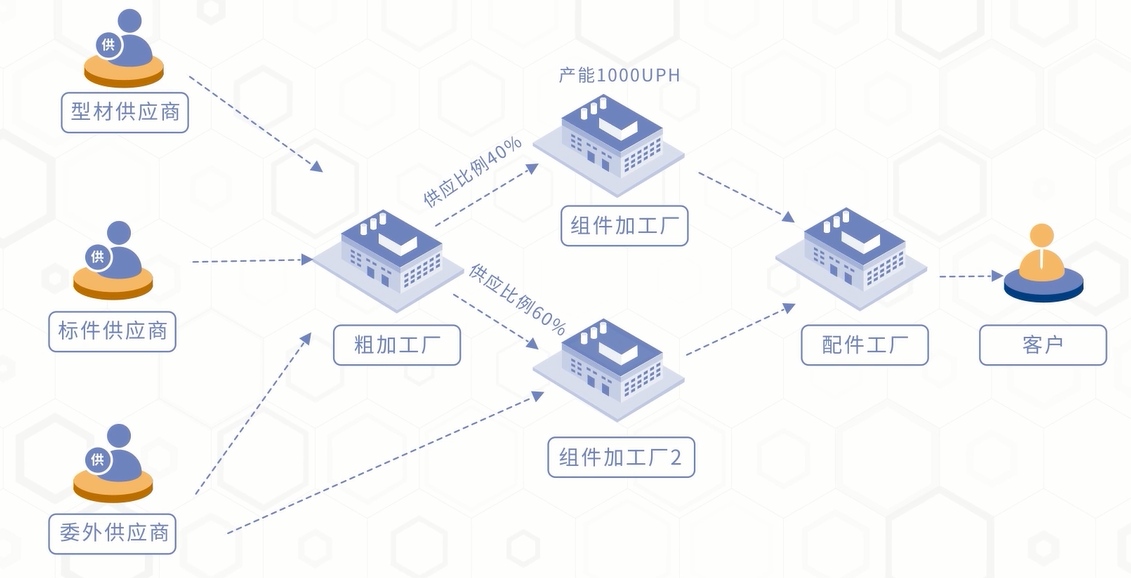
Taking a typical machine shop as an example, its standard manufacturing process clearly illustrates the synergy between planning and scheduling: first, the machining workshop performs multiple processing steps on core components; then, all semi-finished products are uniformly transferred to the surface treatment area for processes such as blasting and painting; depending on product characteristics, some parts are returned to the machining workshop for secondary precision machining, while others are sent directly to the final assembly workshop for assembly; after all processes pass inspection, the products are finally warehoused and archived, awaiting shipment. Throughout this process, the APS system not only plans the overall production cycle and resource allocation (planning) but also performs precise real-time sequencing and scheduling for each machine, operation, and material (scheduling), thereby achieving global optimization.
The information flow that runs through the entire production chain and ensures seamless connections between links relies on the full support of production planning and scheduling—both are indispensable. Starting from the N+M monthly production plan, relevant personnel must immediately synchronize with the procurement team and upstream/downstream suppliers to clarify subsequent production requirements, initiate material sourcing in advance, and carefully verify whether the reserve quantities of various materials are sufficient to avoid any supply disruptions later; when advancing to the locked schedule phase, it is necessary to recheck the suppliers' material inventory and in-transit status with precision, and at the same time break down the overall production tasks, specifying the exact start times and production milestones for the machining and final assembly workshops. Simultaneously, the material delivery plan for suppliers as well as the shipping time and demand nodes for the machining workshop must be communicated to ensure uniform rhythm across all links.
In essence, production planning and scheduling themselves are the core of production management, with clear division of labor and collaborative efforts. Planning focuses primarily on the medium- to long-term horizon; its core function is to identify potential issues that may arise during production in advance, accurately confirm whether the required capacity and material resources are sufficient, make early overall allocations, ensure stable supply of capacity and materials, and set targets and provide support for subsequent scheduling. Its essence is to achieve a precise match between demand and supply, addressing potential risks such as medium- to long-term capacity shortages or material gaps, and clarifying key questions like "what to do, when to do it, where to do it, and how much material and capacity are needed."
Unlike planning, scheduling is the concrete implementation and efficient execution of the plan, with a much finer granularity down to hours, minutes, and seconds, dynamically adapting to the actual on-site production situation. Scheduling focuses on the progression of each specific operation, with the core mission of optimizing the production sequence, synchronizing real-time production progress, properly avoiding various priority conflicts and resource conflicts, and specifying "when each operation starts, when it ends, and who is responsible." It executes the established plan in the optimal way, maximizing production efficiency, minimizing waste, ensuring an orderly and efficient production flow, and ultimately achieving production goals while safeguarding delivery timelines.