

 Products & Services







 400 676 5650
Fasteners are a collective term for key mechanical components that securely connect two or more parts (or components) into a unified whole, playing a vital role in the machinery industry. They are widely used in automotive manufacturing, energy development, electronic technology, electrical equipment, and various types of machinery manufacturing.
In recent years, China's fastener industry has shown vigorous development, with the market size continuously expanding. Starting from 95.2 billion yuan in 2012, it rose to 146.5 billion yuan by 2020, with a compound annual growth rate of approximately 45%. By 2023, the market size had further approached 147.5 billion yuan, and it is expected to cross the 150 billion yuan milestone this year. Looking ahead to the next five years, China's fastener industry will continue to maintain steady growth, with the market size expected to exceed 180 billion yuan by 2028. These figures not only reflect the strong strength of China's fastener industry but also indicate its broad development prospects in the future. Among these, technological innovations such as automation and intelligence will become key factors driving the development of the fastener industry.

1. Why Does the Fastener Industry Need Advanced Planning and Scheduling (APS) More?
High Volatility in Raw Material Market
The price of raw materials (such as steel) required for fastener production fluctuates significantly, making it difficult for companies to quickly respond to market changes when formulating inventory and procurement strategies. The uncertainty of market forecasts exposes companies to higher risks in inventory management. Most companies can only stockpile excessive raw materials and semi-finished products, which easily leads to overstocking and increases operational costs.
Advanced Planning and Scheduling systems can help companies optimize inventory strategies and reduce raw material costs through precise forecasting and market analysis capabilities.
Difficulty in Coordinating Multi-Process Production and Insufficient Resources for Bottleneck Processes
Fastener production typically involves multiple processing steps, with significant differences in cycle times across steps, making it difficult to coordinate scheduling. Certain critical processes (such as cold heading and hot forging) have limited capacity, and equipment changeover times are long, leading to severe bottlenecks. Moreover, uneven allocation of furnace resources further exacerbates low production efficiency and increases production complexity.
Advanced Planning and Scheduling systems can comprehensively consider the production capacity and demands of each process, enabling seamless transitions between processes. They identify and optimize bottleneck processes, improving overall production line efficiency through rational scheduling and resource allocation.
Large Variety of Product Specifications
Fastener products widely cover three major areas: daily household use, industrial applications, and equipment manufacturing. The daily household category typically includes expansion bolts used in home decoration. Industrial applications involve various bolts used in vehicles such as automobiles and motorcycles, home appliance manufacturing, and construction engineering. The equipment manufacturing sector includes fasteners required for large machinery, equipment, and ships. Additionally, product technical standards are complex and diverse, including national standards, industry standards, and non-standard specifications, further increasing scheduling difficulty.
Advanced Planning and Scheduling systems use intelligent scheduling algorithms to flexibly address the challenges of diverse product specifications and complex technical standards, achieving efficient production and precise scheduling.
High Requirements for Dimensional Accuracy
The product dimensions in the fastener industry vary widely, from tiny household expansion bolts to large fasteners for equipment manufacturing, all of which must comply with established dimensional standards. Even minor dimensional deviations can cause the entire assembly process to fail and may affect the performance and safety of the final product. To meet these requirements, production companies must consider not only the quality of raw materials, the limitations and compatibility of production equipment, but also the product's process flow and processing technical specifications when scheduling, which adds difficulty.
Advanced Planning and Scheduling systems can use scheduling algorithms tailored to different product requirements, referencing dimensional standards to optimize the scheduling process, thereby reducing the risk of assembly failure caused by dimensional deviations.
Low Efficiency in Delivery Date Assessment
When customers inquire about delivery dates, planners typically rely on extensive manual operations for assessment, which is time-consuming and error-prone. Inaccurate or untimely delivery date assessments can undermine customer trust, leading to order loss.
Advanced Planning and Scheduling systems use intelligent algorithms to automatically and quickly assess delivery dates, reducing manual work and improving both accuracy and response speed.
Frequent Demand Changes Leading to Numerous Plan Adjustments
Market demand changes frequently, leading to numerous plan adjustments. However, on-site production often deviates from plans, resulting in low resource utilization and wasted capacity, ultimately leading to low plan achievement rates.
Advanced Planning and Scheduling systems can dynamically adjust production plans and optimize resource allocation, ensuring that on-site production follows the plan, thereby improving resource utilization and plan achievement rates.
Rigid Resource Allocation
Traditional scheduling methods rely on personal experience and subjective judgment, making it difficult to comprehensively and dynamically consider factors such as market demand changes, raw material supply fluctuations, and production equipment status. This not only limits the ability to address complex demands but also easily leads to resource misallocation, such as idle or overloaded production lines, raw material overstock or shortages, preventing maximum improvement in production efficiency.
Advanced Planning and Scheduling systems can comprehensively consider multiple factors including market demand, raw material supply, and production equipment status, enabling optimal resource allocation and improving resource utilization.
2. Practical Example of Fastener APS
A fastener joint-stock company in the Jiangsu-Zhejiang-Shanghai region, with an annual output of 45,000 tons and annual self-operated export volume exceeding $43 million, is a leading enterprise in China's fastener nut industry. It was among the first batch of specialized and new "Little Giant" enterprises recognized by the Ministry of Industry and Information Technology in 2019, ranking first-tier in domestic market share.
Currently, the original plant faces challenges of full production capacity and technical capabilities lagging behind market demands. The leadership adheres to high standards of automation, informatization, and digitalization in establishing the new plant. It is equipped with two brand-new fully automated warehouses, achieving AGV and RGV linkage in production. Centered around a digital core and using the Alps Huipai APS supply chain resource planning platform as the command and dispatch center, a modern factory system is being built. The goal is to create a fully automated "lights-out factory" to address the issue that existing systems cannot meet global scheduling needs, driving the entire factory toward intelligent lean production.
1. Pain Points:
PART.01
When urgent orders are inserted, it is difficult to accurately predict their specific impact on existing production plans; frequent changes in customer demand lead to failure to fulfill customer order commitments on time. Current scheduling strategies only focus on bottleneck processes and fail to achieve fine-grained scheduling across all workshops and processes.
PART.02
The order volume is large, involving hundreds of thousands of process-level scheduling tasks; work order types are diverse, including both mass production and sample trials; order process flows are complex, requiring careful arrangement and coordination of upstream and downstream processes.
PART.03
Production equipment is diverse, totaling thousands of units; products have complex and variable special requirements for equipment, and equipment time calculation is cumbersome. Moreover, when equipment fails, the production plan cannot be automatically adjusted to adapt to changes.
PART.04
The rules and constraints involved in scheduling are intricate, making it difficult for original scheduling to be accurate, leading to significant deviations between plans and actual execution; continuous production between processes and special process requirements result in low resource utilization, affecting overall production efficiency; management and control of fixtures and tooling face challenges; insufficient supply from upstream processes leads to material shortages, further exacerbating production bottlenecks.
To quickly respond to demand changes, handle urgent order insertions, improve production efficiency, and reduce scheduling costs. Therefore, it was decided to introduce a more advanced and professional Huipai APS supply chain planning platform to optimize planning and scheduling and improve delivery capabilities.
2. Solutions
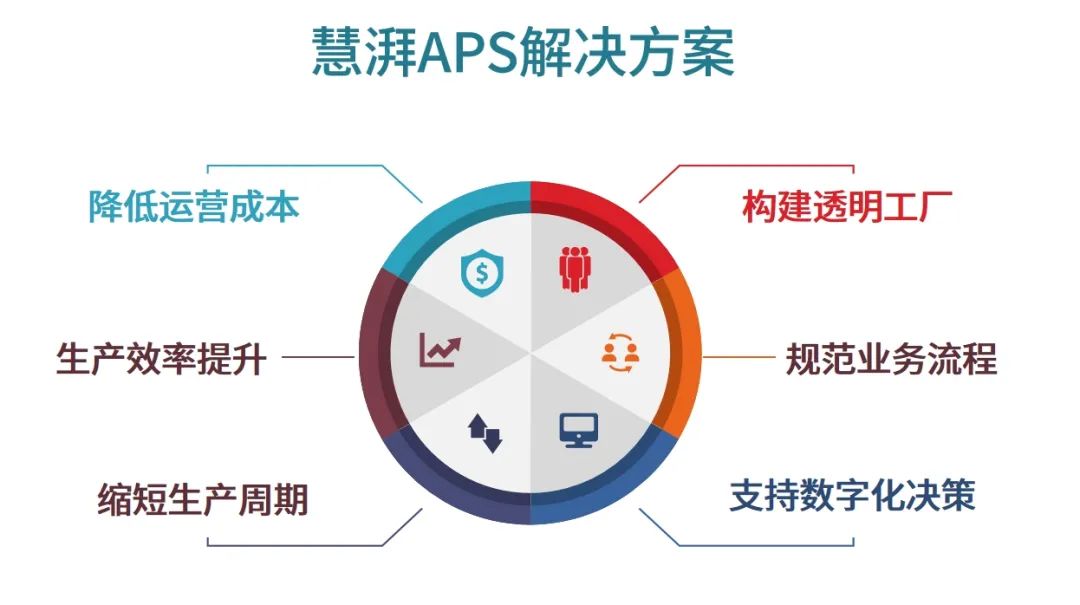
01 Reduce Operating Costs
By introducing the Huipai APS system, automated methods replace traditional manual scheduling processes, effectively reducing valueless manual statistics and repetitive calculations, thereby significantly improving planners' work efficiency. When production anomalies or order changes occur, the system can also respond quickly and make timely adjustments, reducing waiting waste and lowering enterprise operating costs.
02 Improve Production Efficiency
The Huipai APS system automatically performs production scheduling based on order delivery deadlines as the core benchmark. The system dynamically considers multiple rules and constraints such as actual on-site conditions and resource load capacity, formulating a production plan with fewer changeovers and more scientifically reasonable unit-time efficiency, thereby significantly improving production efficiency.
03 Shorten Production Cycle
With the powerful functions of the Huipai APS system, combined with multiple factors such as personnel allocation, equipment status, tooling inventory, and material supply, capacity is rationally planned and allocated, and the execution sequence of production instructions is optimized. This avoids unreasonable resource allocation such as "people waiting for equipment" or "equipment waiting for materials," effectively shortening the overall production cycle.
04 Build a Transparent Factory
The Huipai APS system integrates existing enterprise systems such as MES, WMS, and ERP, enabling information sharing and flow, breaking down information silos. It ensures that departments such as production, design, planning, procurement, and sales can obtain necessary data in a timely manner, achieving high transparency and collaboration, helping to reduce communication costs and improve management efficiency.
05 Standardize Business Processes
The Huipai APS system deeply integrates lean management philosophy and TOC (Theory of Constraints) principles, optimizing and strengthening mechanisms for order insertion and modification. By accurately identifying and eliminating various redundancies and waste in production and non-production support processes, it helps enterprises significantly reduce operating costs and build a more efficient and lean operational mechanism.
06 Support Digital Decision-Making
The Huipai APS system can collect and provide real-time on-site data, offering strong data support for multiple links such as production planning and scheduling, material procurement management, resource allocation optimization, and performance evaluation. At the same time, the system provides management with more accurate and reliable decision-support information.
3. Benefit Improvements
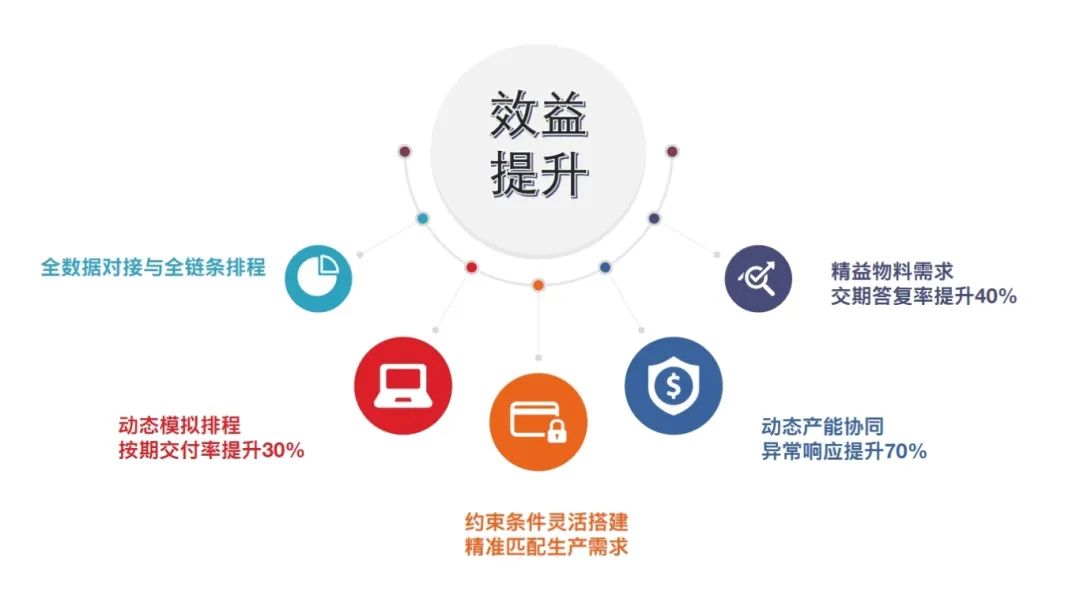
01 Full Data Integration and Full-Chain Scheduling
The Huipai APS DPS Advanced Production Scheduling system achieves full data integration. Its powerful data integration capability enables the system to seamlessly connect with other systems such as ERP, MES, and WMS, precisely dispatching various production management systems, providing comprehensive support for the entire factory's intelligent lean production.
02 Dynamic Simulation Scheduling, On-Time Delivery Rate Increased by 30%
Unlike traditional APS methods where data is reported manually by order followers after the fact, the Huipai APS system can automatically collect production data in real time, ensuring that when urgent orders or order insertions occur, production plans can be quickly adjusted. It accurately predicts production progress and delivery times, increasing the on-time delivery rate by 30%.
03 Flexible Constraint Setup, Precise Matching of Production Needs
The Huipai APS supports flexible setup of multiple constraints, comparison of multiple scheduling results, and intuitive display of scheduling results via Gantt charts. Users can manually adjust the Gantt chart to quickly modify production plans, meeting complex on-site production needs, achieving collaborative management across the entire production process, and further optimizing the production flow.
04 Dynamic Capacity Coordination, Anomaly Response Improved by 70%
An integrated digital planning system is built to quickly achieve multi-level planning linkage, collaborative manufacturing planning, capacity alignment, and significantly improved anomaly response efficiency.
05 Lean Material Requirements, Delivery Date Reply Rate Increased by 40%
Material requirement release is triggered in conjunction with capacity load time, and the rhythm of material procurement and warehouse material levels are managed leanly. A quick delivery date assessment that considers both capacity and material conditions is created, adapting to different business objective assessment requirements, increasing the delivery date reply rate by 40%.