

 Products & Services







 400 676 5650
In today's VUCA era—an environment filled with volatility, uncertainty, complexity, and ambiguity—the smart factory manufacturing industry is facing a major turning point in its history. The operational management methods that were effective in the past are gradually proving inadequate in the face of such rapid changes and unpredictable demands. Just like the law of survival in nature, only those who adapt can endure. Therefore, developing a new operational model that conforms to the current situation has become a key task for the manufacturing industry to break through.
In the next two installments, we will delve into the new manufacturing operating model in the VUCA era and how to meet these challenges through the digital upgrade of planning management.
1. Severe Tests Facing Traditional Enterprise Management and Operations
1. Human resource difficulties and rising costs: Currently, with the accelerating trend of population aging and rising labor costs, enterprises are facing recruitment difficulties, which pose severe challenges to maintaining production efficiency and cost control. Enterprises need to find a balance under the dual pressure of scarce human resources and increasing costs.
2. Return on investment in high-end equipment is lower than expected: Although many enterprises have spared no expense to introduce cutting-edge technological equipment, due to factors such as insufficient operational skills and mismatched management processes, the effectiveness of these devices is often not fully realized. This not only increases the capital expenditure of the enterprise but may also lead to inefficient use of resources.
3. Transformation of production model is imminent: The increasing market demand for product diversity and customization is forcing traditional enterprises to shift from large-scale, single-product production to flexible multi-variety, small-batch production models. This transformation requires enterprises to enhance their production flexibility to respond agilely to rapidly changing market demands.
4. Intense market competition and supply chain volatility: In an increasingly competitive market environment, the survival space of enterprises is severely squeezed. At the same time, the uncertainty of the supply chain intensifies, bringing unprecedented challenges to the production and sales links of enterprises, requiring them to enhance the resilience and adaptability of the supply chain.
5. Risk of declining customer satisfaction: With the diversification of consumer preferences and the rise of personalized needs, traditional enterprises face the arduous task of meeting a wide range of customer demands. A decline in customer satisfaction not only damages the brand reputation of the enterprise but may also lead to customer churn, further affecting the long-term development and market share of the enterprise.
2. Various Problems Force Manufacturing to Undergo Upgrading and Transformation
Promote the company's "continuous winning" through the path of "continuous improvement"
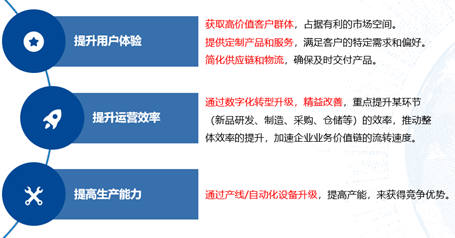
All industries are being impacted, and the transformation and upgrading of the smart factory manufacturing industry has become the core driving force pulling many industries into a new round of growth. Innovation and development empowered by new technologies have become the inevitable path for enterprises to break through at the strategic level. Different types of enterprises may have different core objectives for transformation and upgrading, depending on their specific internal and external environments.
3. Companies Have Done So Much Upgrading and Transformation, Yet It Has Not Led to Revenue and Profit Growth
1. Products have become similar in function, quality, and price; orders are lost because delivery deadlines cannot be met.
2. Due to delivery issues, companies cannot secure a larger supplier allocation, or orders are canceled because of late delivery.
3. Even when they secure orders with increased allocation shares, they still incur losses—revenue increases but profits do not.
4. Either production halts while waiting for materials, or employees are forced to work overtime to catch up on schedules, leading to complaints.
Einstein said: Problems at one dimension must be solved by rising to the next dimension, not by stubbornly struggling within the same dimension.
Adjusting at a single point has limitations; it cannot fundamentally change the operational capability shortcomings, nor is it conducive to creating synergy. It may even lead to conflicts and internal friction between different optimizations.
The superficial symptoms of an enterprise are low internal equipment utilization, low production efficiency, high costs, long production cycles, and low management transparency. The root cause is insufficient ability to respond to external customized and uncertain demands.
"Planning management" is about rising one dimension to take a holistic view and solve problems comprehensively—like looking down at a maze from a high-rise building.
4. Enterprises Have Carried Out Upgrading and Transformation at Various Points, But "Planning Management," the Brain of the Factory, Still Uses Traditional Methods, Failing to Link R&D, Sales, Supply, Production, and Service
With 1% of problems in planning, execution requires 10 times the effort to compensate. The current state of enterprise planning management:
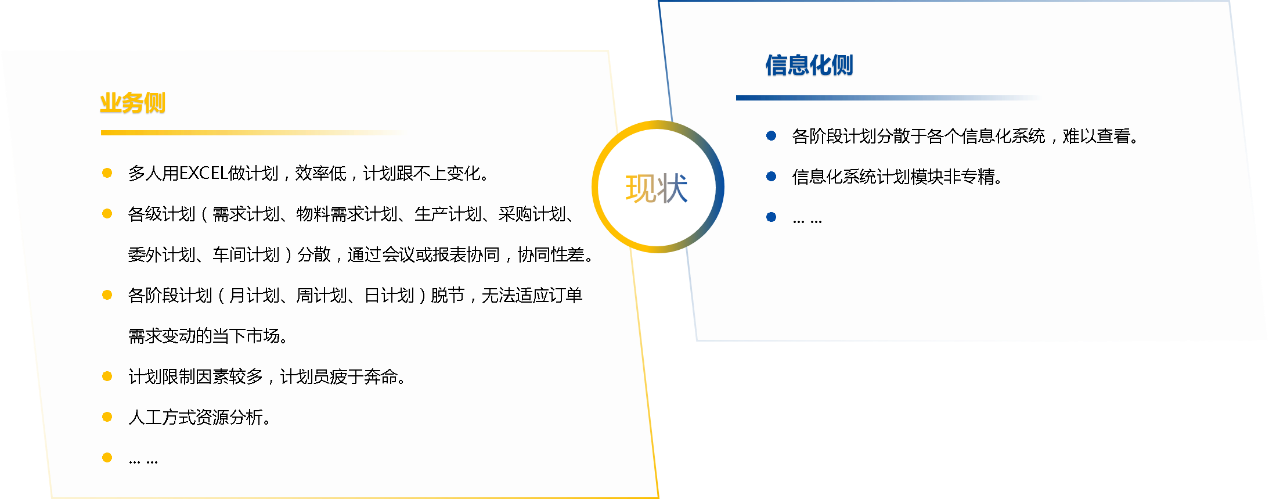
Every function makes its own plans, leading to multiple-plan problems. Among multiple plans, at most one can be correct. Errors ultimately manifest in inefficient use of inventory, capacity, and resources. Creating a unified plan is the foundation for cross-functional collaboration.
Traditional production operation plans focus heavily on the formulation and execution of internal production and material requirements plans, giving little consideration to the systematic nature of the external supply chain and the response cycles of external-related enterprises. This model can no longer meet the increasingly intense market competition demands; enterprise production management must break free from the limitation of "material requirements as the planning center" and instead build a supply chain production operation planning model oriented toward "customer demand."
5. Characteristics of Ideal Planning Management
1. Comprehensive coordination and balanced perspective: Ideal planning management should be based on the overall enterprise, focusing on meeting market demands while considering the enterprise's resource and capacity constraints. Through precise capacity analysis and forecasting, ensure a precise match between customer demand and enterprise supply capacity, maintaining an optimal state of supply-demand balance.
2. Efficient response to uncertainty: Based on a deep understanding of the internal and external environment, effectively identify various uncertain factors that may arise during operations, and pre-develop response strategies and flexible adjustment plans. Use advanced planning tools and technologies to monitor execution in real time, adapt quickly to changes, ensure dynamic balance between plans and actual conditions, and improve forward-looking and flexible decision-making.
3. Clear and unified business orientation: Build a comprehensive planning system around core business objectives that runs through every link of enterprise operations, from raw material procurement, production scheduling, logistics distribution to financial planning. Every activity closely revolves around common business goals, ensuring all departments and processes are aligned, forming strong synergy to advance corporate strategy implementation.
4. Internal and external collaborative optimization: Emphasize high-level collaboration among departments within the enterprise and between the enterprise and supply chain partners. By establishing open information sharing platforms and collaboration mechanisms, ensure that various functional units within the enterprise and upstream and downstream enterprises in the supply chain can work based on common goals and plans, achieving seamless integration of information flow, logistics, and capital flow, promoting efficient operation and continuous optimization of the entire supply chain system, and jointly enhancing the overall competitiveness and response speed of the supply chain.
Four Characteristics: Holistic + Real-time/Timeliness + Synchronization + Dynamism
The planning management system should be a fusion of informatization and digitalization. Informatization provides basic management tools and methodologies, while digitalization drives continuous business improvement through data analysis and self-feedback mechanisms. This process covers multiple fields such as manufacturing science, management science, and data science, collectively forming the core of the planning management system.
6. Digital Upgrade of Planning Management is the "Answer" for Enterprise Operations in Today's "Uncertain" Environment
In the rapidly changing VUCA era, the manufacturing industry is undergoing unprecedented transformation. Traditional operation models and planning management methods can no longer adapt to the rapid market changes and the trend toward personalized and diversified customer demands. The rapid iteration of technology requires manufacturing enterprises to meet these challenges with an innovative attitude and agile strategies. Against this backdrop, the digital upgrade of planning management has become the only way for manufacturing transformation and upgrading.
In the next article, we will continue to delve into the new manufacturing operation model in the VUCA era and explore the mysteries of the digital upgrade of planning management. Stay tuned!