

 Products & Services






 400 676 5650
In the previous edition, we delved into the significant advantages brought by the "AS" (Advanced Scheduling) functionality within APS (Advanced Planning and Scheduling): It not only greatly enhances scheduling efficiency, enabling optimized production plan adjustments and ensuring timely customer order delivery while effectively reducing inventory costs, but also, through its highly granular resource allocation capabilities, significantly improves production completeness rates and resource utilization efficiency, providing robust support for enterprises transitioning to flexible manufacturing and achieving production balance.
So, what benefits can the "AP" (Advanced Planning) component of APS bring to enterprises? This edition will reveal the answer.
AP stands for Advanced Planning.
Speaking of planning, it precedes scheduling. Planning must be done first, followed by scheduling. Planning and scheduling are two distinct stages: planning belongs to the pre-production phase, meaning it must be completed before production begins, while scheduling belongs to the in-production phase. Planning is a coarse-grained selection process—simply put, it determines what the factory will produce, how much, when, and what materials and resources are needed.
Generally, enterprises need to establish three levels of plans:
1. Sales and Operations Planning (S&OP Plan)
The S&OP plan is typically executed once a month, rolling over a medium-term period of 12 months. It primarily forecasts future capacity planning, production preparation, material planning, and financial planning.
2. Master Production Schedule (MPS)
The MPS is usually executed once a week, rolling over a short-term period of 15 days to about one month. It varies depending on the SKUs of enterprise orders, delivery dates, and quantity requirements.
3. Daily Operations Plan
This is the scheduling plan mentioned earlier. The daily operations plan is typically executed once a day, rolling over 1 to 2 days.
The S&OP plan generally involves aspects such as resource allocation, information sharing, process optimization, sales forecasting, and inventory management. Its goal is to ensure smooth, efficient, and coordinated production and sales processes, meet market demands, and enhance enterprise competitiveness.
AP Planning Functionality in APS
It primarily brings the following benefits to enterprises:
- Rapid delivery date confirmation
- Improved supply chain collaboration efficiency
- Lean procurement implementation
- Enhanced enterprise risk resilience and competitiveness
In manufacturing, delivery date confirmation has always been a challenge for enterprises. Many companies face this dilemma:
- When a large order arrives, they dare not accept it, fearing insufficient capacity;
- When an urgent order arrives, they also dare not accept it, fearing they cannot deliver on time.
- If they refuse orders, the enterprise struggles to survive; if they accept them, constant delays lead to customer complaints and reputational damage.
At its core, the problem often stems from a lack of scientific evaluation when accepting orders.
Some enterprises act too rashly—
Sales or the boss simply "shoot from the hip" when providing a delivery date:
While cautious enterprises organize multiple departments like PMC, design, warehouse, and production to calculate and verify, only to find that by the time results are available, the business opportunity has slipped away.
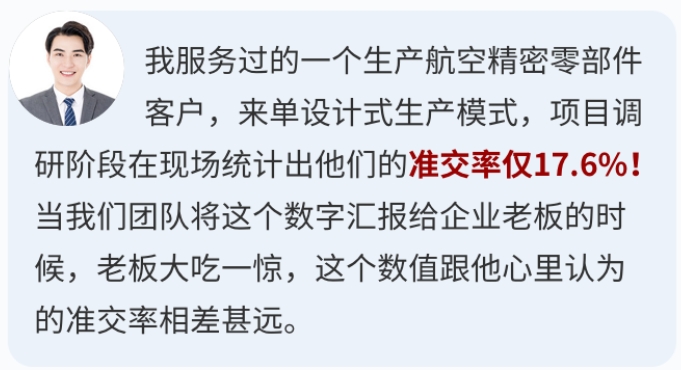
Sometimes, a digital system serves this purpose: it contrasts your assumptions with reality, giving you a clear picture of your enterprise's operational status.
The APS system's planning module can easily resolve this dilemma. Its simulation scheduling function allows you to simply input an order into the system and, with one click, calculate the earliest possible delivery date based on existing scheduling rules, planning strategies, and production constraints. If the date does not meet the customer's requirements, a backward simulation can be performed: input the customer's desired delivery date, and the system will show the adjustments needed to other existing production orders and the resulting impact to fulfill this order.
Additionally, for parts that require outsourcing, the system can generate outsourcing plans while managing and monitoring the progress of suppliers or other group factories within the supply chain, helping enterprises coordinate resources and maintain overall control.
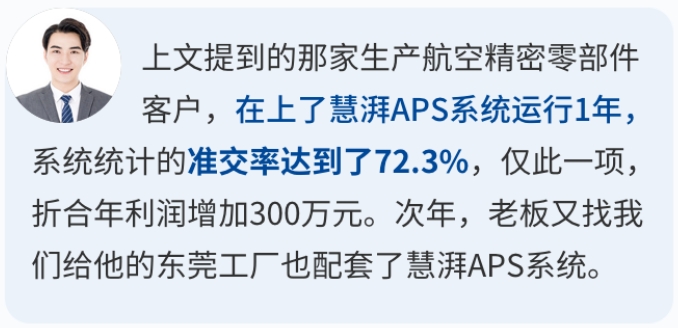
High inventory and capital occupation are also critical issues for enterprise survival.
1. Short delivery times and frequent order changes in the auto parts industry;
2. Long design-to-order lead times in the precision components industry;
3. High-value, long-lead-time materials in the SMT industry;
4. Raw material price volatility in the fastener industry, requiring enterprises to stockpile large quantities of steel, etc.
These enterprises often adopt a high-inventory model to buffer capacity issues. However, high inventory means high capital occupation. Capital is the lifeblood ensuring the continuity of production and operations. High capital occupation brings significant risk to the enterprise and also affects its investment decisions.
The S&OP and supply collaboration planning functions of the APS system can solve these problems:
1. Based on S&OP and supply collaboration plans, long-, medium-, and short-term procurement plans can be developed. Production plans drive the rhythm of procurement and delivery, reducing inventory pressure and improving inventory turnover rates. This avoids situations where materials are lacking for desired production runs while excess inventory accumulates for unwanted ones.
2. It also enhances collaboration across departments. Procurement, planning, production, sales, and warehouse departments can all access and upload data from the same system, ensuring real-time data sharing, eliminating information gaps, accelerating collaborative response speeds, and enabling lean procurement and lean inventory management. This reduces unnecessary capital occupation, improves the enterprise's risk resilience, and supports sustainable development.
The APS system acts like the enterprise's brain, connecting various intelligent management systems. It integrates and analyzes data, performs computations, and directs various departments to work together toward a common goal, optimizing the enterprise's profit. As manufacturing moves toward small-batch, multi-variety production and flexible supply chains—amid fierce internal competition today, tomorrow, and in the future—the APS system will occupy an increasingly important position.