


 Products & Services








 400 676 5650
The implementation and go-live of a customized APS system (Advanced Planning and Scheduling) is a highly specialized project. To ensure its successful deployment, constraints such as delivery dates, capacity, resources, and the impact of ad-hoc changes must be fully integrated into mathematical models. This enables fully automated production plan management and deviation adjustment, eliminating omissions caused by human factors and making it easier to detect global shifts triggered by local changes. Consequently, the production plan becomes executable, observable, and adaptable.
To effectively implement an APS system and transform production planning into an intelligent scheduling system, a professional team is required to engineer algorithm models tailored to the factory's workflows during the pre-implementation phase. By integrating this engineered system into daily factory management, intelligent manufacturing goals can be achieved seamlessly.
APS algorithm model engineering is the process of converting APS theory into practical applications. It involves precisely distilling business details and rules, and translating complex algorithm models into operable mathematical models.
Below is a detailed explanation of APS algorithm model engineering:
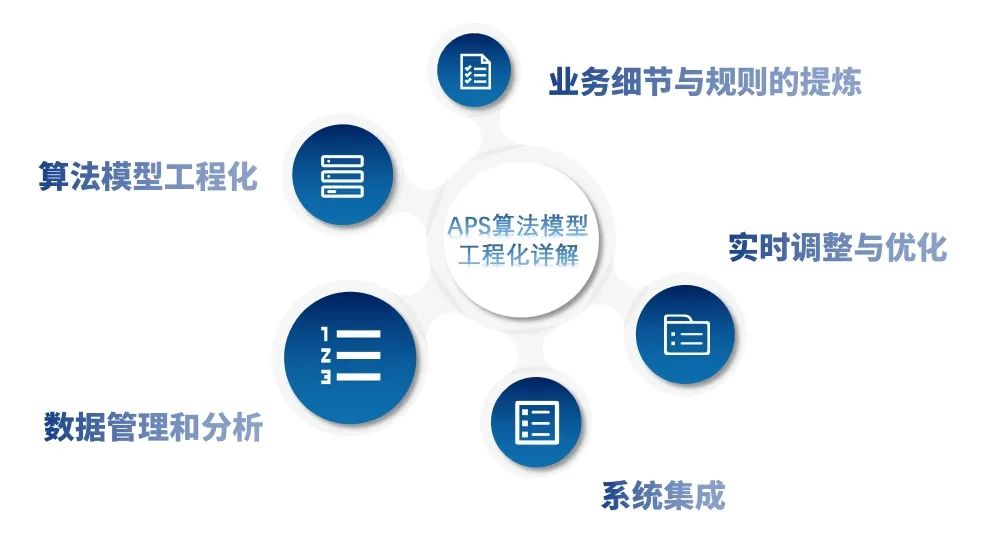
01 Distillation of Business Details and Rules
The APS system aims not only to digitize production data and automate processes but also to rapidly, automatically, and intelligently schedule production plans based on existing resources, and to optimize those plans accordingly.
In manufacturing supply chain management, the supply chain network must be abstracted into models—using directed graphs to represent the network, generating dynamic networks based on product BOMs and processes, supporting various process types and flexible manufacturing, and handling subcontracting, OEM, and rework processes.
Each industry's production follows specific process requirements, and companies impose their own business and process constraints based on unique needs. Therefore, APS vendors must possess a high level of business abstraction capability to ensure project implementation and deployment.
02 Algorithm Model Engineering
A major challenge in APS implementation lies in the complex engineering of algorithm models. This process requires converting business problems into precise, operable mathematical models, with independent programming for different objectives and constraints during the project execution phase.
APS systems also employ heuristic algorithms to encode and mutate business problems in response to dynamic changes. Heuristic algorithms provide a flexible and efficient way to generate new solutions, but this is technically demanding, involving abstract encoding of business problems and engineering abstraction.
The application of deep reinforcement learning algorithms further increases implementation difficulty. These algorithms combine the power of deep learning with the decision-making capabilities of reinforcement learning to solve complex decision problems. However, their learning and modeling processes demand substantial computational resources and technical support.
Rule-based algorithms also pose challenges. Key business constraints must be abstracted into complex relationships between entities, including process flows, resource allocation, and product dependencies. These dependencies are typically represented in engineering implementations as two-dimensional tables, decision trees, or scorecards, and the computational processes handling them require precise system configuration.
03 Data Management and Analysis
Challenges faced by APS systems often stem from a company's data management and analysis mechanisms. Data accuracy and completeness are the foundation of a successful APS system. If data collection is flawed—such as inaccurate, untimely, or incomplete information—the system's ability to identify problems is severely weakened.
The lack of an effective quantitative indicator system is another key obstacle. Without a clear, measurable set of business operations and performance indicators, the APS system struggles to monitor and evaluate effectively, hampering early problem detection.
04 System Integration
The APS system must integrate with existing enterprise information systems (e.g., ERP, MES, MRP) to obtain necessary data and exchange information. This typically involves designing and implementing a data middleware layer or API interfaces.
05 Real-Time Adjustment and Optimization
The APS system must be capable of real-time adjustment and optimization of production plans. During operation, if dependencies between tasks change or other anomalies occur, the APS algorithm can promptly adjust the scheduling sequence to meet new constraints.
APS algorithm model engineering is a complex process requiring a high level of expertise. The implementation team must possess deep mathematical and programming skills, as well as a thorough understanding of business operations and the ability to solve problems flexibly. Additionally, since APS systems are closely tied to core business workflows, implementation requires close collaboration with relevant departments to ensure system effectiveness and practicality.

Alps Smart Manufacturing is an industrial management software company incubated by the Alps Alpine Group. Leveraging long-term experience with SAP, MOM, and APS across 22 group factories, the company has deep insights into upstream and downstream APS business, information products, and on-site factory needs. Alps is also a core partner of Dassault Systèmes in smart manufacturing, with extensive implementation experience for Fortune Global 500 and multinational enterprises, particularly excelling in industries such as machining, automotive parts, 3C, and fasteners for digitization and business scenario deployment.
We provide full-lifecycle software services—from requirement analysis and solution design to system integration, optimization, and debugging—ensuring the APS system is implemented in the customer's factory in the fastest and most satisfactory form, helping enterprises achieve digital and intelligent transformation.