


 Products & Services









 400 676 5650
The ERP system already includes production scheduling functionality, so why is it still necessary to deploy the APS Resource Planning System? Essentially, ERP scheduling is "real quantity + fake time," which struggles to meet dynamic and complex production demands. So, what exactly is the core difference between ERP scheduling and APS scheduling? Today, we’ll dive deep into the details and unveil the mystery!
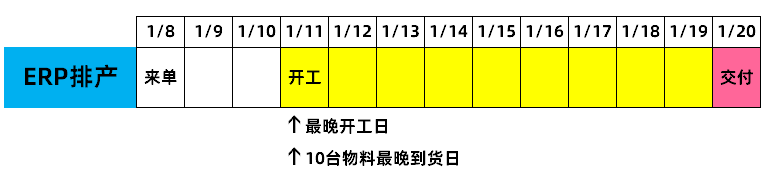
First, ERP systems can schedule production because of the MRP module (MRP: Material Requirement Planning). However, those who have used ERP scheduling know that it is not only based on infinite capacity but also on backward scheduling from the delivery date.
What are infinite capacity and backward scheduling? Infinite capacity means not considering resource constraints, while backward scheduling calculates the latest start time by working backward from the delivery date. Let’s illustrate with an example:
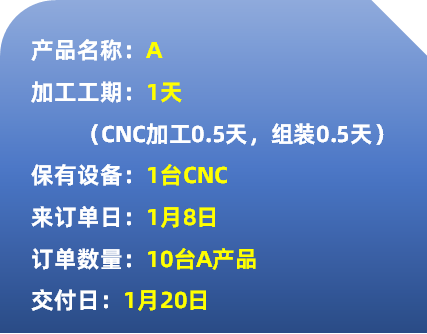
For instance, suppose the production cycle for Product A in a factory is 1 day: it requires 0.5 days of CNC machining and 0.5 days of assembly, and the factory has one CNC machine. On January 8, an order for 10 units of Product A is received, with a customer delivery date of January 20. After the ERP’s MRP calculation, the factory needs to start production on January 11, and all materials for the 10 units must arrive at the warehouse before January 11. The start date of January 11 here is the latest start date, calculated by backward scheduling from the delivery date of January 20 and the 10-day production lead time.
What happens if the APS system calculates?
First, APS considers the current date—whether there is idle capacity from January 9 to 11, whether there are work-in-progress (WIP) items and raw materials, and whether early production can be scheduled. Second, after calculation, APS might find that production can start on January 10 and delivery can be made by January 19, with the required raw materials potentially arriving in batches from January 10 to 18.
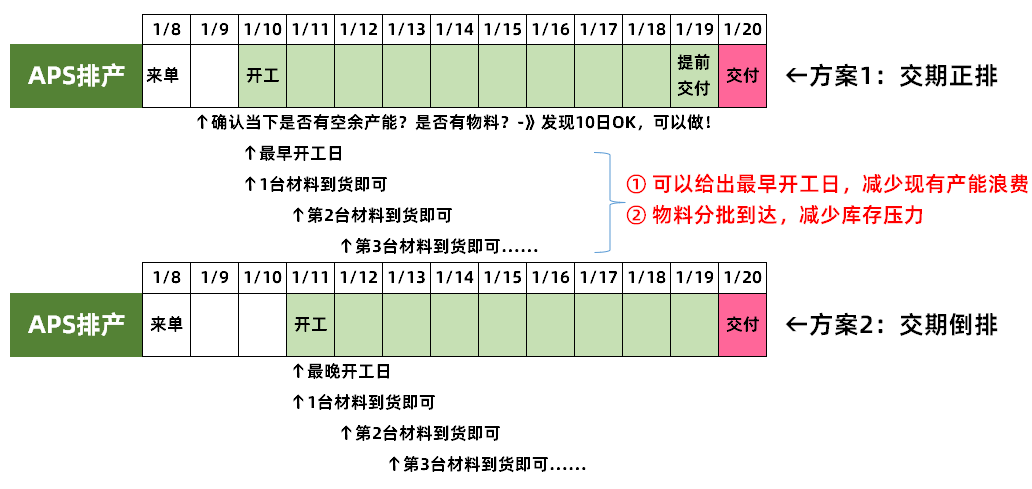
Therefore, the advantages of the APS system are clear:
First, the APS system schedules based on actual production conditions. It considers real-time factors such as WIP, semi-finished goods, inventory, materials, equipment, and personnel, which may affect production and resource constraints. It also supports forward scheduling, backward scheduling, and simulation scheduling, providing globally optimal start date plans. Moreover, the APS system’s simulation scheduling function helps enterprises provide rapid delivery date responses for customer inquiries.
Second, the APS system facilitates lean procurement. By considering the inventory of semi-finished goods, finished goods, and WIP, combined with the actual production plan, it feeds real material requirement plans back to ERP, enabling ERP to output batch procurement plans, thereby reducing inventory pressure and capital occupation.
Do you think that’s the only difference between ERP scheduling and APS scheduling? Not so fast—now comes another order: on January 9, an additional order for 10 units of Product A arrives.
Under ERP’s infinite capacity calculation, two possible outcomes may arise: First, production still starts on January 11, requiring materials for 20 units of Product A. Second, because a predefined lead time can be set in ERP, the system might give a start date of January 3 (a past date). Clearly, both plans are infeasible, as they merely provide material requirement plans without considering constraints or rules. Manual adjustments and outsourcing arrangements would be necessary.
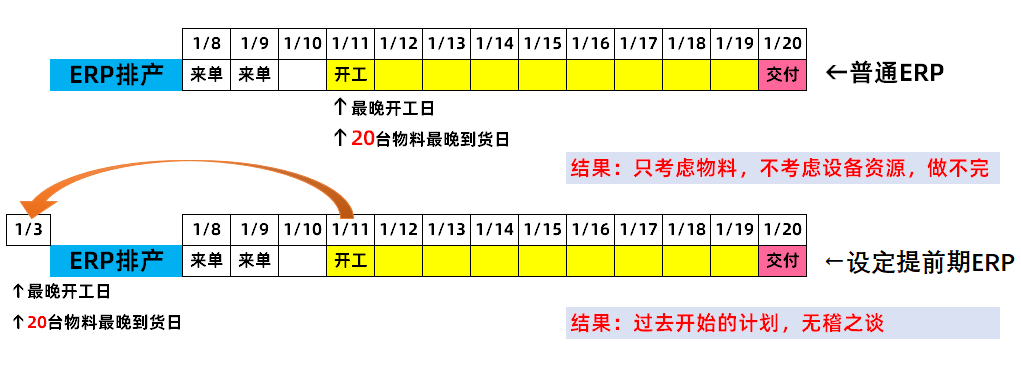
Now let’s see how the APS system performs
First, the APS system considers the current situation—capacity load, whether WIP can be adjusted, inventory status, whether other orders with later delivery dates can be adjusted, availability of production materials, equipment, and production line operators. After evaluating all these factors, APS might propose a plan: start production on the afternoon of January 9, and by January 20, 13 units can be delivered; the remaining 7 units of Product A need to be outsourced starting January 12.

Some attentive readers may ask: why can 13 units be delivered in 12 days?
This leads to another advantage of the APS system: it enables scheduling at the workshop operation level, maximizing the merging of identical processes, reducing changeover and setup time, and increasing capacity. By coordinating the quantities of WIP and semi-finished goods, APS ensures delivery dates are maximally met and provides realistic outsourcing and material requirement plans. We’ll explain how APS merges processes in a future article.
In summary, APS demonstrates powerful advantages in production scheduling, lean procurement, and delivery date responses, serving as an effective complement to ERP scheduling. Welcome to follow [Alps Intelligent Manufacturing] or "Huipai APS." We look forward to your attention and discussions.