

 Products & Services






 400 676 5650
Today, with the evolution of manufacturing, mass production is gradually shifting toward small-batch, diversified models, and customized production is becoming a new trend in the manufacturing industry and smart factories. As the VUCA era arrives, market volatility increases, sales forecasting becomes more difficult, and uncertainties grow more complex. Flexible production methods—characterized by small batches, high variety, and short order cycles—are emerging as the mainstream form of production.
Flexible production presents manufacturing enterprises with growing scheduling challenges:
- Low sales forecast accuracy—many companies achieve only around 50% accuracy
- Production planning still heavily relies on human experience and judgment
- Difficulty in confirming customer delivery dates—average delivery accuracy is only about 60%
- Increasing emergency orders and changes—sales are hard to predict, and the shop floor struggles to cope
- Material shortage issues—inventory piles up while raw materials needed for production are insufficient
- High variety and low volumes lead to complex processes, and real-time task adjustments have significant impacts
These scheduling pain points will resonate deeply with many manufacturing companies. As a critical element of lean production, if planning and scheduling are approached with lean thinking principles—by reducing resource waste, maximizing output with minimal input, and responding rapidly to market demands—the bottlenecks of flexible production can be effectively resolved.

As a company deeply rooted in manufacturing for over 30 years, ALSI has a profound understanding of lean production and continuous improvement on the shop floor. Through ongoing research and exploration, ALSI has leveraged its accumulated expertise to develop the "Huipai Supply Chain Management Platform," featuring a self-developed scheduling algorithm engine. Based on operations research optimization and employing machine learning methods, it automatically evaluates and selects the best solution from a vast array of options. By integrating lean principles, it helps enterprises optimize and adjust internal and external resources and production capacities through automated decision-making, enabling rapid assessment and response to changes.
The "Huipai Supply Chain Management Platform" refines the operation of the entire enterprise or workshop to the granularity of process-level management, enabling detailed linkage and coordination. It supports decision-making for top management and staff across various departments in real-world application scenarios.
The "Huipai Supply Chain Management Platform" encompasses all functions of supply chain and factory-level APS:
- A self-developed low-code platform based on microservices, using SaaS solutions to help SMEs enhance production decision-making and management capabilities. Multiple decision optimization models support multi-objective optimization and simulation analysis across various business scenarios.
- Sales & Operations Planning (S&OP) integrates sales forecasting, capacity planning, and production scheduling within the supply chain, helping enterprises with macro-level medium- to long-term strategic planning.
- Single-factory Supply Chain Planning (SCP) drives the master plan through demand planning. Under various constraints, it uses mathematical algorithms to find the optimal procurement plan, production plan, and scheduling plan.
- Detailed Production Scheduling (DPS) utilizes scheduling models under various constraints, breaking down to the line, equipment, tooling, personnel, and resource levels to generate executable, detailed job-level schedules.
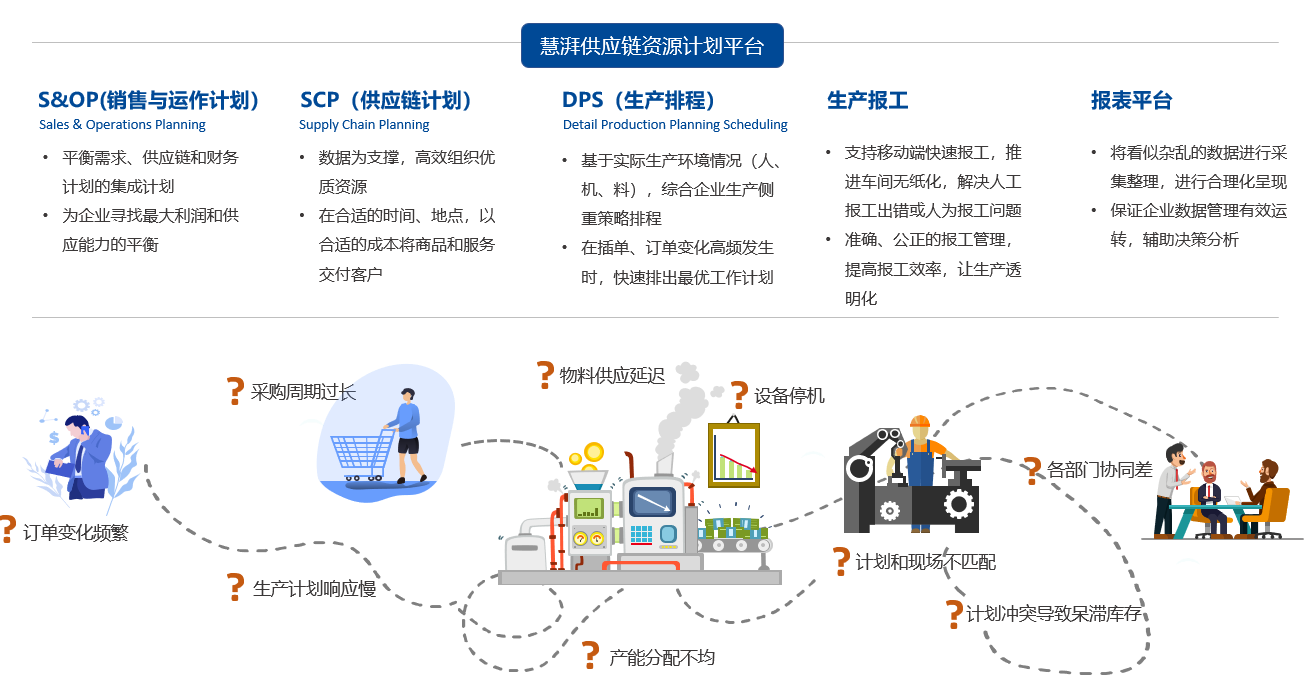
The "Huipai Supply Chain Management Platform" can truly serve as an enterprise decision support system, enhancing cross-departmental, cross-domain, cross-system, and overall supply chain integration capabilities. It effectively addresses issues such as difficulty in assessing customer order delivery dates, low manual scheduling efficiency, low equipment resource utilization, low production plan execution rates, mismatch between material plans and production plans, inventory buildup, and production material shortages, helping enterprises achieve digital and intelligent transformation.
ALSI Perspective:
Lean principles form the foundation of enterprise intelligence:
- Achieve lean practices on the basis of standardized business processes
- Use IT systems to manage lean processes, realizing informatization
- Enable data flow across information systems, making business metrics and results clearly visible for digitization
- Shift from human decision-making based on data to system-driven decision-making, achieving intelligence