


 Products & Services






 400 676 5650
Previously: On November 17-18, Alps System Integration (Dalian) Co., Ltd. (referred to as "ALSI") was invited to participate in the "8th International Intelligent Manufacturing (Wuhan) Forum." The forum featured a special summit on "Intelligent Manufacturing Promotion Strategies," where Dr. Zhang Xiaoli, Director of ALSI, delivered a speech titled "Automation ≠ Cost Reduction & Efficiency Enhancement-- IoT + Lean + Digitalization Empowering Intelligent Manufacturing Upgrade and Beyond".
ALSI has organized the speech content for sharing with industry peers to explore transformation and upgrade pathways for manufacturing enterprises.

The following is an excerpt from Dr. Zhang Xiaoli's speech.
⬇⬇⬇⬇⬇⬇
Key Point 2
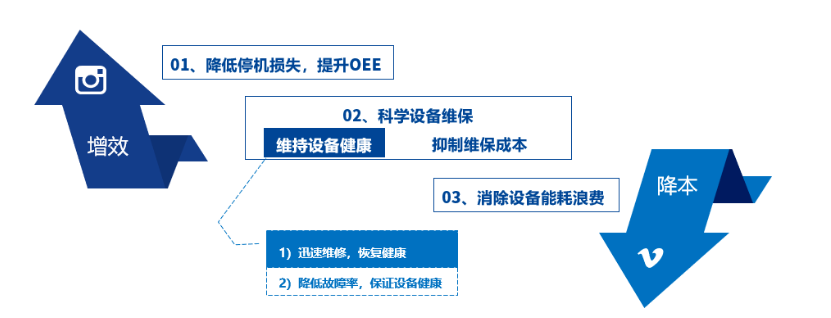
Scientific Equipment Maintenance: Maintaining Equipment Health
Let's first discuss maintaining equipment health. This involves two aspects: one is rapid repair when equipment fails to restore it to health; the other is reducing the equipment failure rate to ensure it remains in a healthy state.
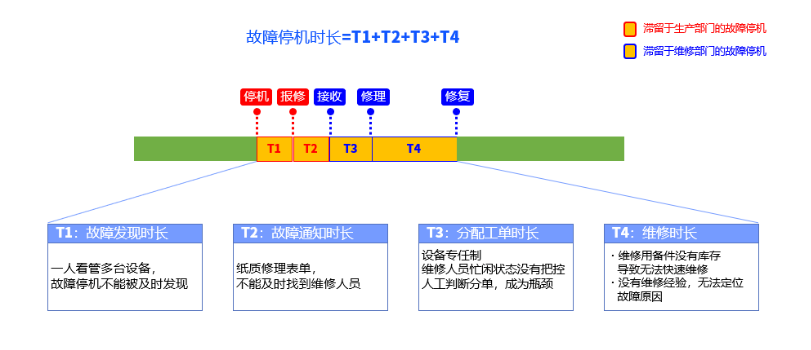
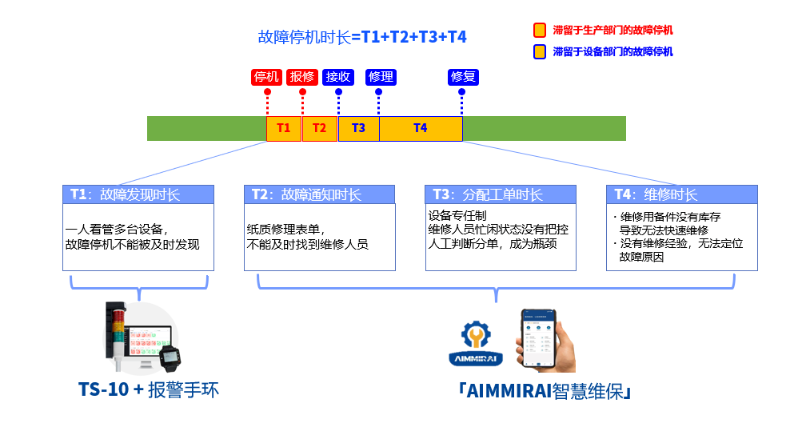
First, consider the first point: how to quickly repair equipment failures and restore health. The equipment failure repair time can be broken down into four segments: T1, T2, T3, and T4.
T1 is the duration to detect the fault. With the advancement of automation and machine replacement, it's common for one operator to oversee multiple machines, causing fault shutdowns to often go unnoticed promptly.
T2 is the duration to notify about the fault. If relying on paper repair forms, the repair information often cannot be promptly communicated to maintenance personnel, especially in large production areas with high noise levels. It can sometimes take 30 minutes or even an hour to notify maintenance staff.
T3 is the duration to assign repair work orders. Some enterprises use a dedicated maintenance system where specific machines are assigned to specific personnel. This often results in waiting until the previous repair is completed before starting another. In contrast, non-dedicated systems see work orders assigned by team leaders, but delays occur due to unknown staff availability or team leaders being busy with other tasks, causing work orders to stagnate.
T4 is the actual repair time. Besides the complexity of the fault, the experience and skill of the maintenance personnel determine the repair duration. Additionally, a lack of spare parts inventory significantly impacts repair time.
Among these four durations, T1 and T2 are spent in the production department, while T3 and T4 are spent in the equipment maintenance department. Together, these four durations determine the total fault downtime. Once equipment "breaks down," we must find ways to shorten these four durations.
01
Rapid Equipment Fault Repair
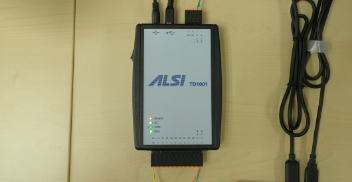
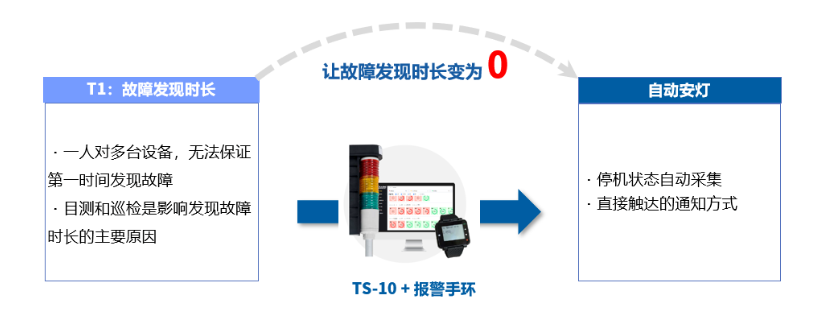
To shorten fault detection time (T1), ALSI's solution is to install an equipment status collection terminal, TS-10, on the equipment. After TS-10 captures the equipment shutdown status, it instantly sends an alert to the production line operator via a smartwatch. This solution reduces fault detection time to zero.
→ Click to view ALSI's solution
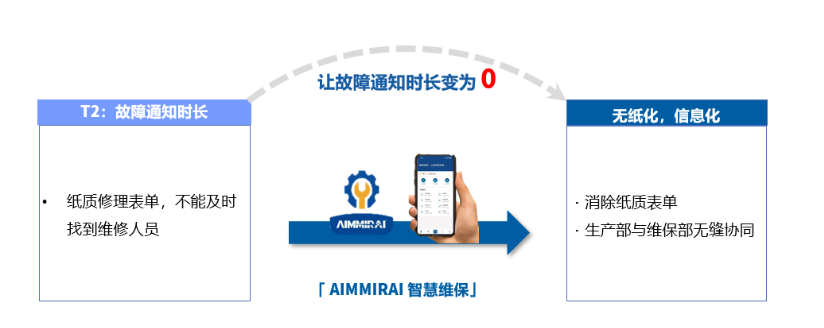
T2 is essentially determined by the smooth collaboration between the production department and the equipment department. Eliminating paper forms and achieving paperless operation enables seamless coordination. ALSI's [AIMMIRAI Smart Maintenance System] can reduce fault notification time to zero.
Scientific maintenance work assignment should consider the following factors: maintenance personnel availability, required skills for the repair, and urgency. Without timely and accurate access to such information, work order assignment may be irrational. For example, assigning a task to someone already occupied with another repair causes waiting, or assigning a task to someone unfamiliar with the equipment leads to failed repairs due to lack of necessary skills. ALSI's [AIMMIRAI Smart Maintenance System] not only provides data support for managers but also intelligently and automatically dispatches orders, making work order allocation reasonable and scientific, thereby significantly shortening T3.
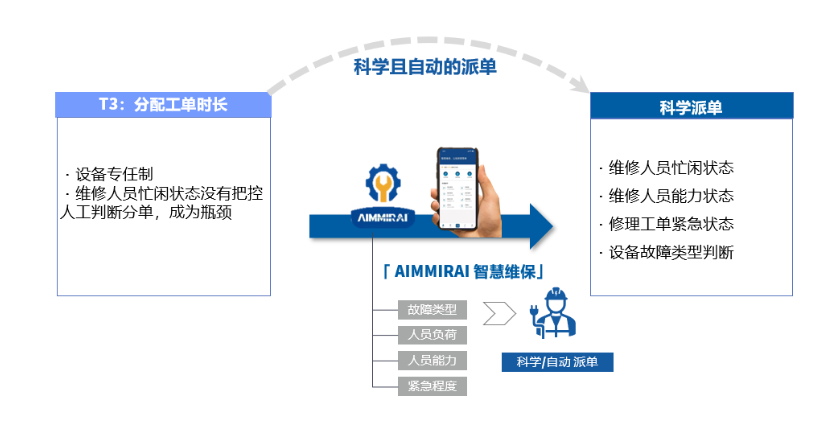
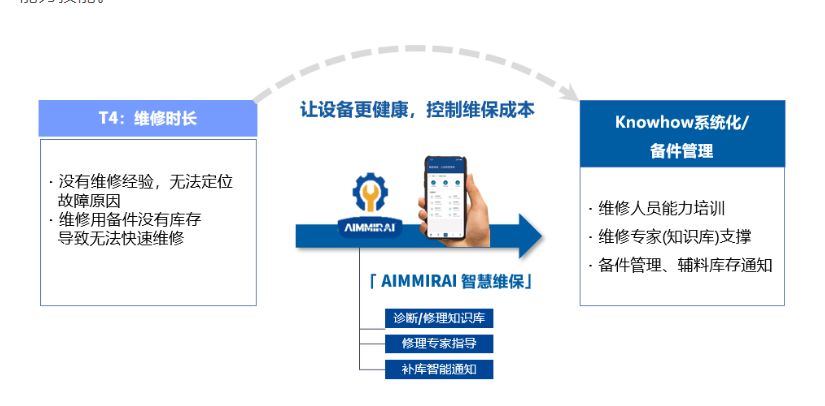
T4 is the actual repair time. Two main factors affect T4:
◇ Personnel skills. Equipment maintenance is heavily dependent on personnel capability. Different skill levels result in significant differences in repair time.
◇ Spare parts inventory. A lack of required spare parts in stock can severely affect repair duration.
ALSI's [AIMMIRAI Smart Maintenance System] leverages features such as a repair knowledge base, expert guidance, and intelligent restocking notifications to digitize repair know-how and scientifically manage spare parts. This reduces repair time while enhancing the skills of maintenance personnel.
In summary, ALSI reduces T1 to zero using the TS-10 and alarm wristband, and shortens T2, T3, and T4 with the [AIMMIRAI Smart Maintenance System].
02
Reducing Equipment Failure Rate
Another aspect of maintaining equipment health is reducing the failure rate—that is, lowering the probability of equipment failure to keep it in a healthy state.
Just as humans undergo regular health check-ups to prevent serious illness, addressing minor issues promptly, and maintaining nutrition and exercise, equipment requires proper preventive maintenance to remain healthy.
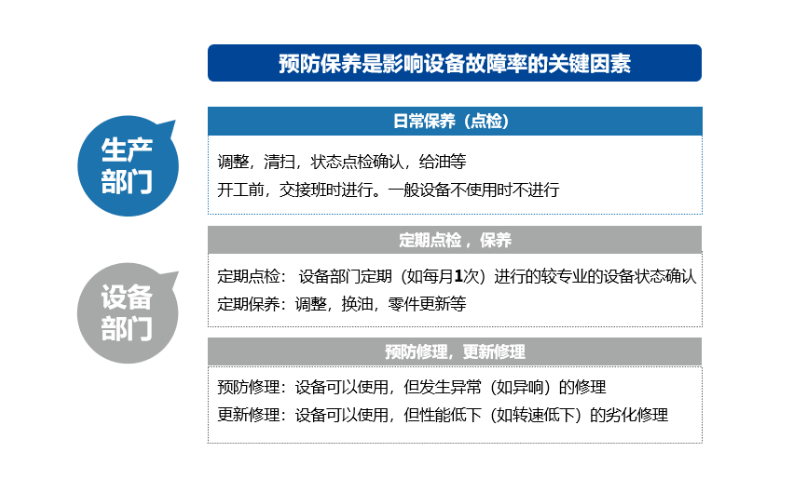
Preventive maintenance for equipment can be categorized into three types:
· First is routine maintenance, or daily inspections. This part is handled by the production department.
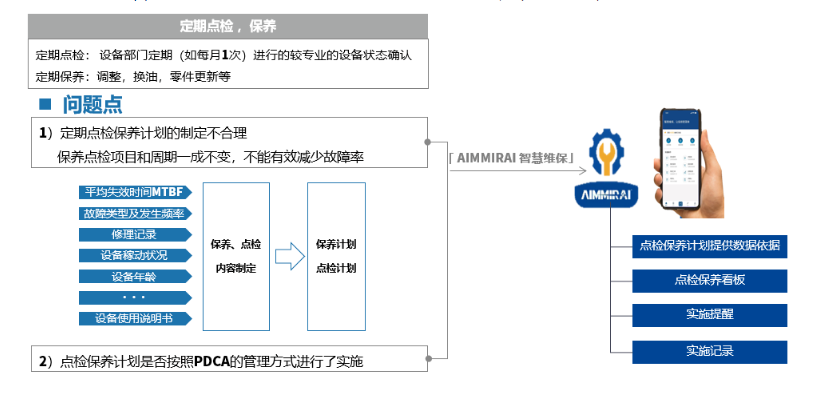
· Second is periodic inspections, where the equipment department conducts more professional status checks at regular intervals (e.g., monthly).
· Third is corrective maintenance performed when abnormalities are discovered during periodic inspections or maintenance—this is called preventive repair. Alternatively, if performance degradation (e.g., reduced rotational speed) is found, it is called renewal repair.
However, most factories face two common issues in implementing periodic inspections and maintenance:
1. Unreasonable planning of periodic inspection and maintenance schedules. The content and intervals remain static, based solely on equipment manuals, without considering each machine's age, operation status, repair history, or frequent failure types. Adjusting inspection content and intervals based on such data is essential to target issues effectively. Additionally, referencing Mean Time Between Failures (MTBF) to adjust intervals can effectively reduce failure rates.
2. The PDCA cycle for inspection and maintenance plans: whether the plan is executed and whether execution records are traceable. Many factories still rely on paper forms, leading to poor PDCA management.
The [AIMMIRAI Smart Maintenance System] effectively addresses both issues, ensuring equipment remains in a healthy state.
Improving equipment OEE and maintaining equipment health both aim to make automation deliver efficiency gains. Regarding cost reduction, ALSI will discuss this in the next 'Lean Perspective' installment.
ALSI will continue to share insights on cost control within scientific equipment maintenance and the third key point. Follow the official WeChat account [ALSI Smart Manufacturing] for the next part of "Automation ≠ Cost Reduction & Efficiency Enhancement-- IoT + Lean + Digitalization Empowering Intelligent Manufacturing Upgrade and Beyond."