


 Products & Services







 400 676 5650
Time:2026-02-04
The APS system breaks down internal information silos within an enterprise, integrating critical data such as order demands, workshop capacity, and material inventory onto a single platform, enabling real-time data synchronization across departments. Previously, order information that required hours of manual cross-checking can now be aggregated instantly using the APS system, eliminating delays caused by lagging information transmission and boosting response efficiency from the source.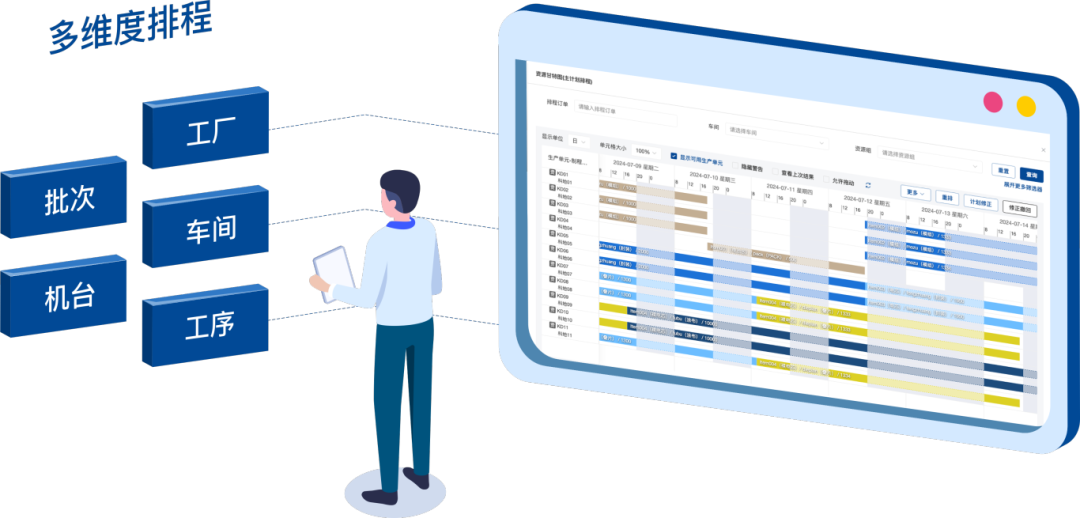
During the production scheduling phase, the APS system prioritizes tasks based on order delivery deadlines, while also accounting for real-world factors such as current equipment load, available personnel, and material arrival times, to automatically generate actionable scheduling plans. This eliminates the need for planners to manually calculate and repeatedly adjust schedules—tasks that previously took one to two days can now be completed in just a few hours, significantly reducing the lead time from order receipt to production commencement.
Throughout order execution, the APS system captures anomalies in real time—such as last-minute changes to order specifications by customers or delays in key material arrivals—and quickly adjusts the schedule while notifying relevant departments like production and procurement. It also anticipates capacity bottlenecks, for instance, when a critical machine is overloaded, it proactively redistributes tasks to other equipment, ensuring orders proceed on schedule.
By integrating data, enabling rapid scheduling, and facilitating dynamic adjustments, the APS system removes bottlenecks across the entire order processing workflow. It not only simplifies planning tasks but also empowers enterprises to respond swiftly to market order fluctuations, adapting to high-mix, low-volume production demands—making it a practical tool for enhancing supply chain agility.