

 Products & Services









 400 676 5650
Auto Parts, also known as automotive components, serve as the core upstream link in the automotive industry supply chain. The auto parts industry lays the foundation for the entire automotive industry's development. Entering 2024, China's auto parts industry has shown a robust growth trend, with a 7.74% year-on-year increase in operating revenue in the first three quarters, and a substantial 23.64% growth in net profit attributable to parent companies. Meanwhile, both gross profit margin and net profit margin have risen. Against this backdrop, the dual transformation towards electrification and intelligence is profoundly reshaping the ecological structure of the auto parts industry. Market competition is intensifying, and enterprises urgently need to explore and cultivate new core competitiveness to flexibly respond to challenges and continuously drive their own development.

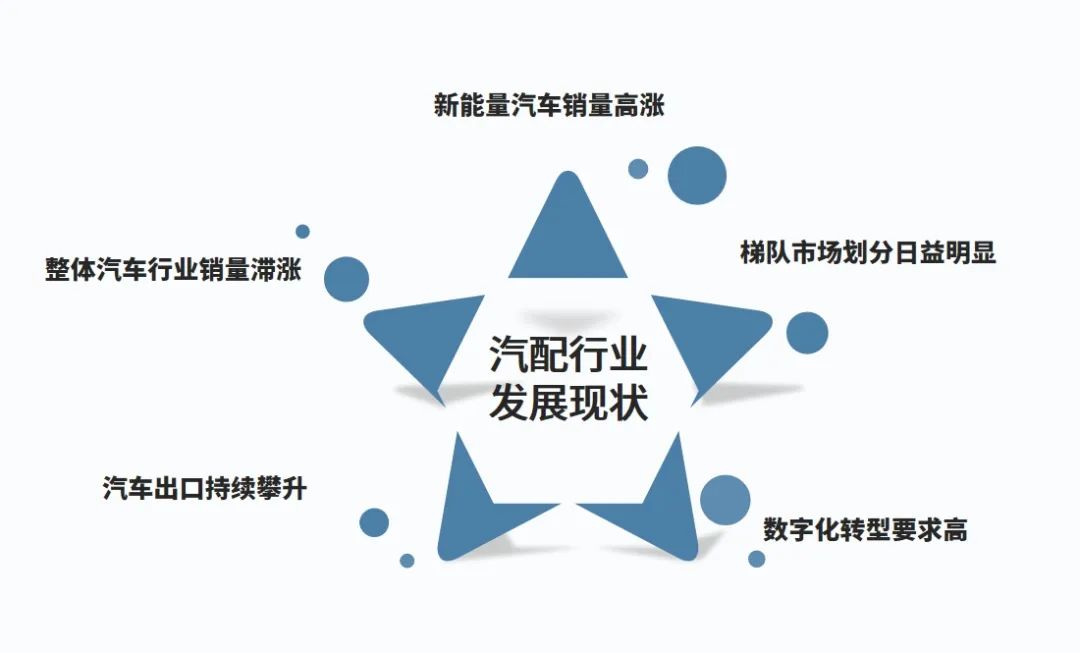
I. Current Development Status of the Auto Parts Industry
- Stagnant Sales Growth in the Overall Automotive Industry
The complex and volatile external environment, including global economic fluctuations, dynamic policy adjustments, and trade frictions and disputes, has brought unprecedented shocks and uncertainties to the automotive industry. On the internal demand side, although residents' purchasing power has improved, consumers' increasingly rational car-buying decisions, their pursuit of diversified automotive product choices, and high expectations for new automotive technologies such as environmental protection and energy efficiency have meant that car-buying intentions have not significantly strengthened as the market anticipated.
- Soaring Sales of New Energy Vehicles
Thanks to a series of policy measures from the National Development and Reform Commission, the Ministry of Finance, and other departments, the momentum of new energy vehicle (NEV) development has become even stronger in 2024. Coupled with significant improvements in key indicators such as range and charging speed, consumer purchase confidence has been enhanced. According to relevant data, NEV market sales are expected to climb to 11.5 million units in 2024, a year-on-year growth rate of 20%. In 2025, the NEV market will maintain strong growth, with sales expected to approach or exceed 13 million units.
- Rising Automotive Exports
Automobiles have emerged as a new engine for China's export trade growth. Especially in the past two years, NEVs have become a key driver of export growth due to their excellent environmental performance, efficient energy-saving characteristics, and substantial improvements in technological innovation and quality. According to relevant reports, China's automobile exports are expected to continue rising in 2024, potentially reaching 5.2 to 5.8 million units, with significant year-on-year growth. In the first three quarters, NEV exports reached 928,000 units, up 12.5% year-on-year.
- Increasingly Clear Tiered Market Division Among Domestic OEMs
As market competition intensifies, the success or failure of transformation has become a watershed for automakers. Take, for example, a certain automotive company that has been established for nearly 40 years and was listed on A-shares earlier due to its broad market influence. In recent years, its continuously declining sales figures reflect the reality of its diminishing market competitiveness.
- Digital Transformation Requirements Higher Than Other Industries
Currently, most domestic OEMs have a relatively high level of digitalization and are at the forefront of the manufacturing industry. Therefore, in order to meet strict quality standards and customer requirements, the auto parts industry must use digital transformation to improve production efficiency, optimize supply chain management, and enhance flexibility and decision-making quality.
II. Difficulties in Production Planning for the Auto Parts Industry
- Highly Volatile Market Demand
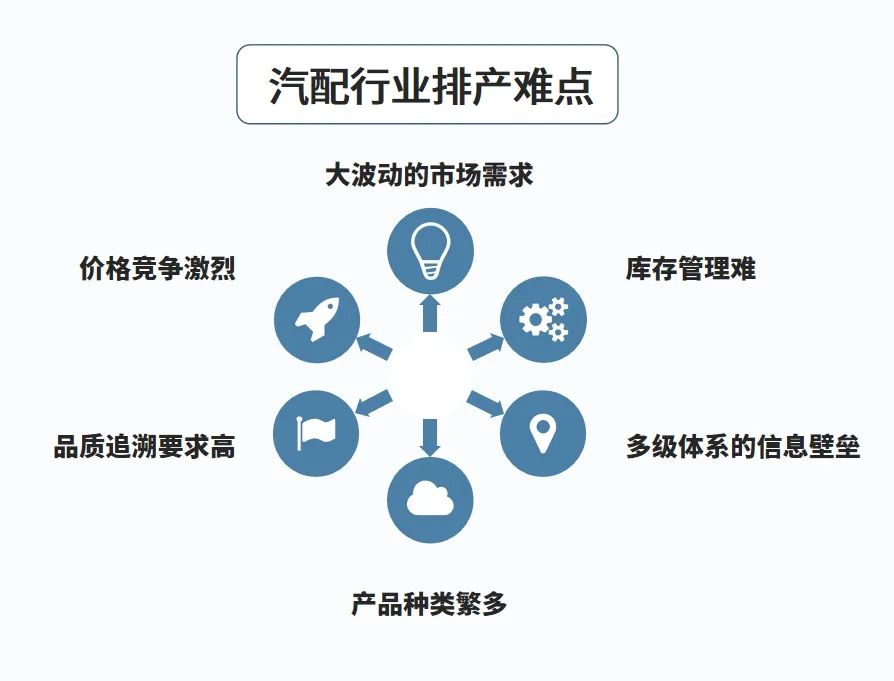
Given the dominant position of OEMs in the supply chain, the auto parts industry must always be prepared to cope with complex and volatile market demand fluctuations. To ensure stable delivery cycles, auto parts companies using manual scheduling often resort to a "stockpiling" model to deal with drastic market fluctuations. Although this strategy effectively ensures market supply, it also brings the challenge of persistently high inventory levels.
- Intense Price Competition
The auto parts industry widely faces price challenges due to annual price reduction strategies. This situation forces companies to continuously optimize their cost structures to maintain price competitiveness. However, excessive cost control may weaken product quality and R&D investment, thereby harming the company's long-term sustainable development capability. At the same time, the annual reduction mechanism intensifies price competition within the industry, leading to a significant reduction in profit margins, placing companies under severe survival tests and operational pressure, making transformation urgently needed.
- High Requirements for Quality Traceability
The quality of auto parts is closely linked to vehicle safety performance, directly related to driving safety and the life and property of vehicle owners. Therefore, establishing a traceability system is particularly critical. Especially in production, comprehensive and detailed data collection and in-depth analysis are required, but this is difficult to achieve manually.
- Wide Variety of Products
The diversification of product lines comes with huge differences in production batch sizes among different products. This may not only lead to frequent switching and adjustments in the production process, but also cause extended production cycles, increased production costs, and uncertainty in delivery times, increasing the difficulty of scheduling.
- Information Barriers in Multi-Tier Systems
In most auto parts companies, data from various business segments such as sales, production, and distribution are scattered and isolated. This makes it difficult to capture urgent fluctuations in market demand in a timely manner and effectively feed them back to the production front-end. As a result, original production plans frequently face adjustment challenges, and manual scheduling cannot quickly respond to dynamic market demands. In addition, the prevalent subcontracting model in the industry means that parts must flow between multiple suppliers for production and assembly, further complicating information collaboration management.
- Difficulty in Inventory Management
To meet OEMs' requirements for immediate material response and given the industry's inherent characteristics of diverse and complex material types and specifications, traditional manual scheduling methods struggle to accurately match the optimal material allocation requirements. This often results in work-in-progress inventory lingering in the production site or third-party warehouses for months, not only occupying significant capital and space resources but also facing risks such as loss and damage, severely impacting the efficiency and effectiveness of inventory management.
III. APS Application Examples
1. Customer Background
An auto parts manufacturing company in Liaoning, listed on A-shares for over 20 years, mainly produces automotive power steering pumps, transmission oil pumps, EPS motors, gear pumps, and other auto parts. Relying on strong R&D innovation capabilities and technical strength, the company has been expanding its scale in recent years. Existing management methods can no longer meet the company's needs. The company has formulated a "Four-Step Intelligent Work" transformation strategy. The scheduling characteristics of this company include: make-to-order, small batch, multiple varieties, frequent order changes, and many rush orders and order insertions, making scheduling upgrade and optimization urgent.
2. Customer Challenges
The customer's existing ERP system could not effectively manage the occupancy of inventory materials, leading to failure to freeze outgoing materials in time, resulting in duplicate material issues and material shortages. The most severe incident caused a production halt of over ten days, resulting in significant waste for the company.
The demand in the auto parts industry fluctuates greatly, so production plans need frequent changes. The existing ERP+EXCEL manual scheduling is inefficient. When order changes occur, it cannot make accurate and fast plan adjustments, repeatedly affecting order delivery.
The on-site execution of production plans currently relies on order coordinators to collect daily information manually and enter it into the computer management system. This process is not only time-sensitive but also unable to make dynamic adjustments and immediate responses in case of emergencies, thereby restricting decision-making efficiency and production flexibility.
The customer's factory has thousands of machines, with a PMC team of nearly 20 people. Information flow between employees is poor, and communication barriers are significant, making it difficult to efficiently allocate and utilize resources. In addition, the customer's production process spans multiple departments such as procurement, design, production, and material management, but there is a lack of effective information transmission mechanisms between departments, severely weakening overall collaborative capabilities.
3. HuiPai APS Supply Chain Resource Planning Platform Solution
After on-site research to fully understand the customer's pain points and needs, the ALSI team proposed a targeted customized solution.
- Using HuiPai APS's SCP Supply Collaboration Planning System, connect existing ERP and MES, collect inventory information in stock, in process, and in transit, check material kitting, and solve the problem of untimely and inaccurate inventory status feedback. At the same time, based on limited personnel, materials, and equipment capacity, make reasonable procurement plans to synchronize procurement with production plans, optimize inventory pressure while ensuring smooth and stable production.
- Based on market demand and the customer's supply chain situation, recommend that the customer differentiate different rolling scheduling cycles (30D, 7D) and production scheduling cycles (1D, 3D). Combined with the introduction of the SCP Supply Collaboration Planning System to optimize controllable factors in the planning process, consider the impact of various constraints on plan feasibility based on limited capacity, ensuring accurate delivery date responses to the demand side.
- Introduce the DPS Advanced Production Scheduling System from HuiPai APS, which can simultaneously consider factors such as personnel processing capability and efficiency, material supply constraints, equipment capacity limitations, and enterprise production optimization strategies and tactics. It calculates the most reasonable processing location for each order on which production line and machine, reducing changeover time and other unnecessary production waste, and improving equipment utilization and production efficiency.
- HuiPai APS seamlessly integrates with the ERP system and tracks various information and execution results in real time during the production process, completely eliminating the traditional manual collection and entry process by order coordinators, greatly improving data processing timeliness and accuracy. At the same time, HuiPai APS has strong dynamic adjustment capabilities. In the face of sudden production situations such as equipment failure or material shortage, it can perform rapid and accurate recalculations and plan adjustments, ensuring that production activities can immediately respond and optimize execution, significantly improving production management flexibility and adaptability.
- After the application of the HuiPai APS system, cross-departmental data resources were successfully integrated, effectively breaking the long-standing "information silos" phenomenon. Core information such as production plans, material requirements, and inventory status is now shared in real time and updated dynamically, forming an efficient collaborative operating mechanism and comprehensively improving the overall effectiveness of production management. At the same time, PMC internal members can communicate instantly through a unified platform to achieve precise control and material allocation.

4. Benefits Realized
- 60% Improvement in Scheduling Efficiency
By integrating production and sales data, reducing duplicate entries, avoiding labor waste, and enabling one-click automatic scheduling, scheduling efficiency improved by 60% after system implementation. It also provides precise control over actual production conditions on site, allowing flexible adjustment of production plans and avoiding rework caused by incomplete information.
- 40% Reduction in Anomaly Response Time
A rapid response mechanism is activated when anomalies occur. This includes assigning a dedicated person to follow up and ensuring that information is quickly transmitted to all relevant departments and personnel. Meanwhile, dynamic and rolling scheduling functions are used to reschedule and formulate the optimal production plan.
- 25% Improvement in On-Time Order Delivery Rate
By collecting and analyzing production data in real time, accurately predicting production capacity and material requirements, optimizing production plans and schedules, and ensuring a smooth and efficient production process. At the same time, quickly responding to order changes and dynamically adjusting production plans reduces production delays and guarantees delivery dates.
- 29.9% Reduction in Inventory Duplicate Usage Rate
Flexibly match common materials, consider procurement in transit and incoming materials, and intelligently synchronize actual workshop production with plans to reduce duplicate inventory usage. Before the system, the inventory duplicate usage rate was 30%; after system use, the inventory duplicate rate dropped to 0.1%, a reduction of 29.9%.
- 10% Increase in Equipment Utilization
PMC personnel use real-time data fed back by the APS system to further adjust and optimize scheduling, reasonably allocate production tasks to each production line, reduce waste, save changeover time, avoid equipment idleness, and improve equipment utilization.