

 Products & Services








 400 676 5650
Since the release of "Made in China 2025" in 2015, when the national government formally introduced the "Internet+" strategy, digital transformation has been underway for nearly a decade. Most leading-edge manufacturing plants have already implemented "digital systems" to varying degrees, such as:
Customized Solutions for Large and Medium Enterprises:
CRM Systems — Managing Customer Relationships
ERP Systems — Managing Procurement, Sales, and Inventory
MES Systems — Managing Production Execution
WMS Systems — Managing Warehouse Inbound and Outbound
Lightweight Solutions for Small Manufacturing Enterprises:
ERP Systems, Small Work Orders, Andon Systems…
Through these digital and IT means, management or business owners can better measure and control production progress and quality in the factory. However, in the past year or two, during customer visits, we have found that more and more enterprise managers are raising the following challenges:
Hundreds or thousands of production orders come in daily, and scheduling is overwhelming!
Customer delivery deadlines are constantly delayed, leading to frequent complaints!
Inventory levels are too high, tying up capital in stock!
How to create medium- to long-term plans for the next 3-6 months or 1-3 years? What needs to be done? How much? What resources are required?
These issues cannot be resolved by MOM, MES, ERP, or WMS…
Some may be unfamiliar with the term "APS," and some may have only heard of it. Indeed, with the flexible development of market conditions, the demand for APS systems has been increasing in recent years. Today, let's discuss:
What is an APS system? What is it used for?
What benefits can it bring to an enterprise?
What types of enterprises need an APS system?
First, scheduling is an ancient and historically significant management method, just like manufacturing itself. The APS systems we use today—Advanced Planning and Scheduling systems—are known as "advanced planning and scheduling" systems in Chinese. APS consists of two parts: Advanced Planning (AP) and Advanced Scheduling (AS). That is, APS actually covers both planning and production scheduling. However, most current APS software on the market primarily focuses on AS, i.e., scheduling. In fact, the main function of APS is to plan and schedule materials and resources based on rules and constraints, enabling enterprises to achieve sales-production coordination, supply coordination, and advanced scheduling through intelligent software.
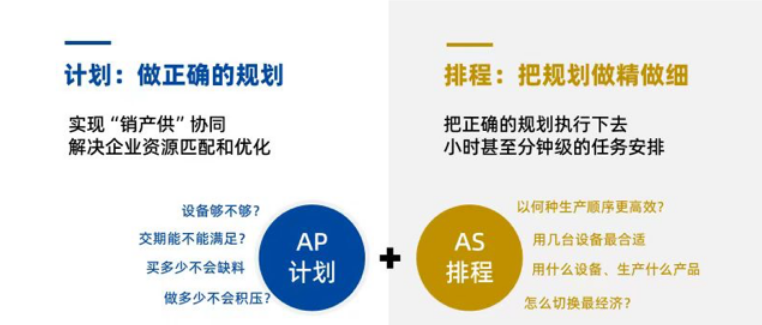
APS Advanced Planning and Scheduling = AP Advanced Planning + AS Advanced Scheduling
Let's explain some terms in the above definition:
"Rules" refer to factors that must be followed during scheduling, such as order priority, delivery date, and preferred equipment.
"Constraints" are divided into hard constraints and soft constraints. Hard constraints refer to the equipment required for production processing and the hours that regulate planned solutions; soft constraints refer to raw/auxiliary material supply cycles, processing technology requirements, human-machine coordination, and whether outsourcing is needed.
"Materials" refer to raw/auxiliary materials, semi-finished products, and finished products required for production.
"Resources" in manufacturing plants refer to production equipment, such as CNC machines and cold heading machines as primary resources, and molds and tools as secondary resources. They also include production line operators. Some workers are single-skill, others are multi-skill, and they may be apprentices or experienced hands. Each worker's performance and quality levels per unit time differ. Different orders require operators with different skill levels. Therefore, operators are also resources that need to be planned.
Next, let's detail the functions of APS. First, let's look at the Advanced Scheduling (AS) function in APS. When it comes to scheduling, all manufacturing managers hope to deliver on time, minimize work-in-progress, shorten customer lead times, and maximize resource utilization. However, these goals often conflict and constrain each other. For example, when resource utilization is low, it is easier to complete order tasks; high inventory ensures high on-time delivery rates, and even customer lead times can be zero... The purpose of production scheduling is to find an optimal balance among these conflicting goals to maximize enterprise benefits. Therefore, the AS advanced scheduling function is a short-term weekly/daily job plan that can specify which production line, which machine, at what time, what product to produce, how much material is needed, what necessary tooling and fixtures are required, and which operator/technician is needed. The APS scheduling function can bring the following benefits to enterprises:
- Improved Scheduling Efficiency
- Optimized Production Plans
- Increased Kit Availability Rate
- Enhanced On-Time Delivery Rate of Orders
Currently, most manufacturing enterprises use manual Excel scheduling combined with order tracker feedback for master production scheduling and daily job plans. They may run MRP (Material Requirement Planning) in the ERP system, then use Excel to calculate the production plan results into weekly or daily job plans, which are then issued to the workshop. The workshop manager arranges the actual production work. The material requirement plan is sent to procurement to create purchasing plans. This scheduling method has two drawbacks:
1. Manual Excel scheduling is inefficient and lacks adaptability.
In one automotive parts company we served with about 5,000 employees,
they had up to 40+ planners (PMC) who performed segmented scheduling by process step. When an order came in, the PMC needed to confirm capacity with production, check materials, semi-finished goods, and work-in-progress with the warehouse, confirm delivery dates with sales, and verify lead times with procurement. Then they compiled the data, applied various constraints, and scheduled based on experience. This scheduling mode is not only inefficient and time-consuming but also limited by the planner's experience and unequal data access, making it difficult to produce a globally optimal production plan with the highest resource utilization. Moreover, if a production abnormality occurs—such as equipment failure, material shortage, or order changes—the principle is to absorb these with capacity, but manual scheduling cannot respond quickly, leading to waste from waiting.
2. ERP's MRP struggles to match real production needs.
Since ERP's MRP is based on infinite capacity and backward scheduling from delivery dates, even the MRP calculated by the ERP system can only provide the latest start date and latest material arrival date, making it difficult to match actual production requirements. Additionally, it splits orders, making it impossible to track how much of a specific order has been completed. For example, consider product A with a production cycle of 22 aT. Assembly takes 1 day. A factory has 2 CNC machines. If a customer order for 10 units of product A arrives on January 8, requiring delivery by January 20, after ERP planning, the factory must start on January 11 (10-day lead time). All materials for the 10 units must arrive at the warehouse by January 11.
If APS calculates this, there are two differences:
(1) APS will consider the current date: is there spare capacity on January 9-11 that could be used to start production early?
(2) If it calculates that production can start on January 10, the required materials may be procured and arrive at the warehouse in batches from January 10 to January 14.
Thus, the APS system can achieve:
1. Forward scheduling based on actual operational status; 2. Batch procurement to reduce inventory pressure.
Continuing this example: if another order for 10 units of product A arrives on January 9, under ERP's infinite capacity calculation,
the plan might still be to start on January 11, or ERP might give a start date of January 3 (a past date) based on preset lead times. Obviously, both plans are impractical, requiring manual outsourcing adjustments.
Now let's look at APS performance: APS, considering current capacity load, whether existing work-in-progress can be adjusted, and the impact on other product delivery dates, will give a production plan that starts in the afternoon of January 9, delivers 13 units by January 20, and outsources 7 units on January 12.
Why can 13 units be delivered?
Because APS scheduling can maximize the consolidation of orders with the same process, reduce changeover time, increase capacity, and coordinate work-in-progress and semi-finished goods quantities to maximize on-time delivery while providing realistic outsourcing and material requirement plans.
In summary:
- ERP's MRP calculates "true quantities" + "false times." In contrast, APS systems bring clear benefits in scheduling efficiency. PMC can obtain real-time information on procurement, production, inventory, and outsourcing, then rely on preset rules and constraints and APS's powerful computing power to produce a globally optimal schedule that guarantees delivery, minimizes changeovers, achieves relatively high resource utilization, and maintains low inventory. This is especially true in industries like 3C electronics, machining, and equipment manufacturing, where there are many materials, shared materials, complex processes, and bottleneck operations. APS's computing power far exceeds manual Excel scheduling.
- Furthermore, the production plan calculated by APS can provide more accurate material requirement plans, outsourcing plans, and procurement plans based on finite capacity, feeding back to ERP and WMS systems. This allows ERP to issue procurement, outsourcing, and outbound orders based on actual production needs, pulling production operations. This not only improves kit availability but also reduces inventory levels, eliminating the high inventory buffers many companies set to ensure delivery. It truly achieves balanced and flexible manufacturing: "produce what is needed, have the materials needed, and avoid producing what is unnecessary."
The benefits of "AS" in APS include: significantly improved scheduling efficiency, optimized production plans, ensured on-time delivery, and reduced inventory. At the same time, through detailed resource scheduling, it enhances kit availability and resource utilization, supporting enterprises in achieving flexible manufacturing and balanced production. What about the benefits of "AP"? Stay tuned for the next issue for a detailed explanation.