

 Products & Services




 400 676 5650
ALSI has compiled the speech content to share with industry peers for discussions on transformation and upgrading approaches for manufacturing enterprises.

The following is an excerpt from Dr. Zhang Xiaoli's speech
⬇⬇⬇⬇⬇⬇
New Challenges Brought by Automation
Under the wave of intelligent manufacturing, it is an inevitable trend for enterprises to promote automation. During the process of advancing automation, many manufacturing companies, including our parent company Alps Alpine Group, find that this journey is not always smooth. After introducing automated equipment, enterprises face many new changes.
The first change is in the labor structure. After adopting automated equipment, the proportion of operational roles gradually decreases, while technical roles increase. At the same time, due to the introduction of advanced automation equipment, problems that cannot be handled by operational staff also increase significantly. Solving these problems increasingly relies on the professional skills and experience of technical personnel, making standardization difficult.
The second change is in the cost structure. Among all expenses, the cost of purchasing machinery and equipment is not the largest. Currently, the price of a robot has dropped to under 100,000 RMB. Even if it replaces just one worker, the cost can be recovered within about a year. The larger expenses are subsequent energy consumption and maintenance costs. For example, due to a shortage of talent, hiring professionals skilled in industrial robot programming and maintenance requires substantial expenditure. Replacing manual labor with robots is not simply about purchasing and installing the equipment; it involves changes in the entire production and management model, such as recruiting operators, equipment wear and maintenance, production organization, and management adaptability. If any issue is not handled well, the enterprise may be exhausted before the robots even begin working.
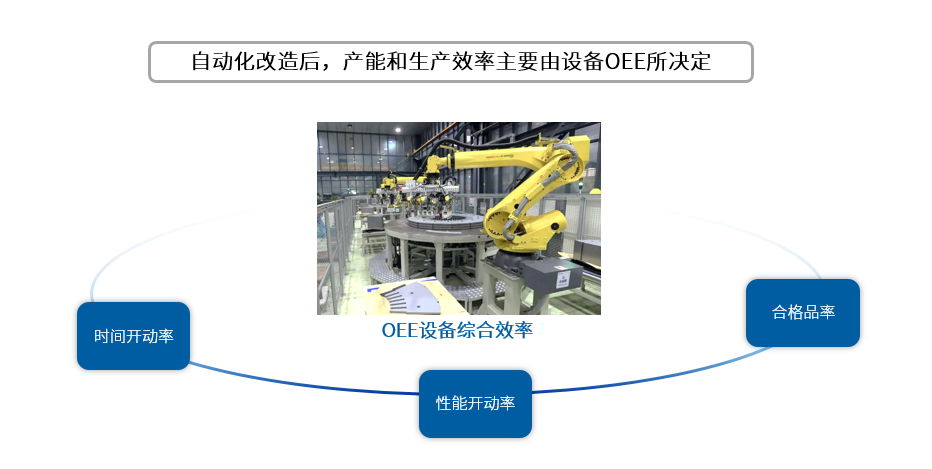
The third change is the increased impact of equipment overall efficiency on production efficiency and capacity. After factory automation, production capacity and efficiency are primarily determined by the Overall Equipment Effectiveness (OEE). This means improving OEE becomes increasingly important—indeed, OEE can be seen as a proxy for production efficiency and capacity. Currently, the OEE level in domestic factories is still quite low, likely around 30-40%. If automated equipment frequently breaks down, it may be less efficient than manual labor and fail to achieve cost reduction.
Three Key Points to Solve the New Challenges of Automation
Although automation introduces new problems, it is undoubtedly the necessary path for intelligent manufacturing. Our task is to solve these issues.
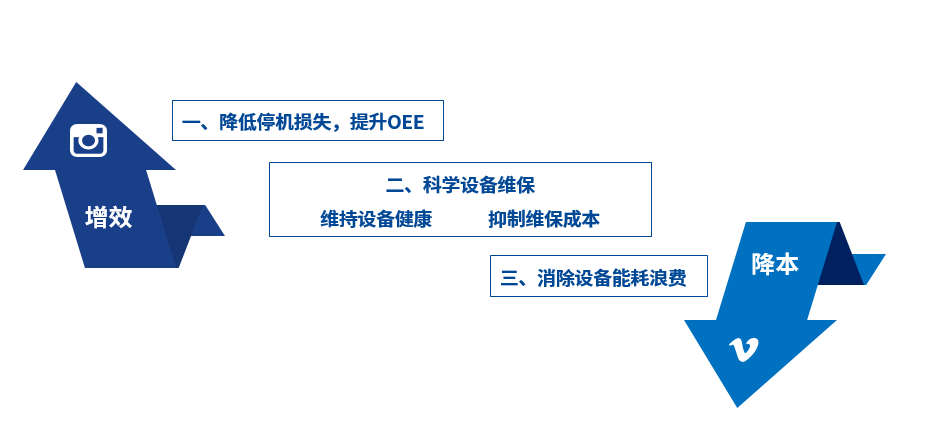
To this end, ALSI believes we need to address the problem from three aspects:
1. Reduce equipment downtime losses and improve OEE;
2. Strengthen scientific management of equipment maintenance to ensure equipment health while controlling maintenance costs;
3. Monitor equipment energy consumption and power usage to curb energy waste.
Key Point 1: Improve OEE
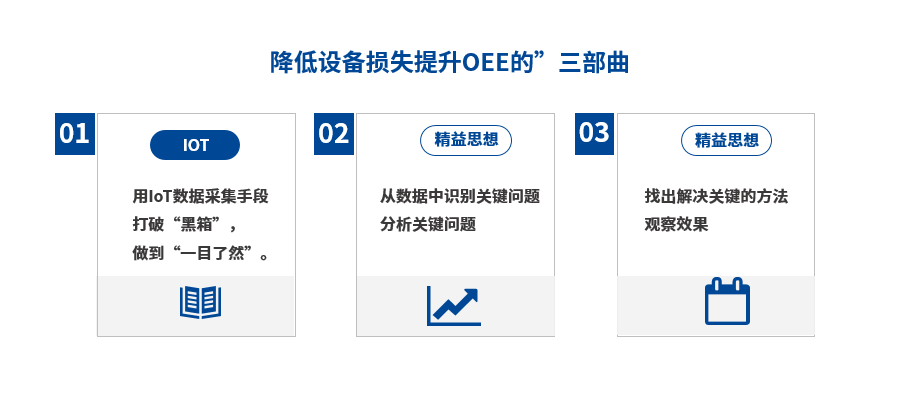
In this edition of 'Lean Insights,' we will first explore the first key point: how to reduce downtime losses and improve equipment OEE. Based on over 30 years of hands-on experience on the manufacturing floor, ALSI has summarized a three-step process for improving OEE.
Step 1: Use IoT data collection methods to gather data affecting OEE, breaking the black box of the manufacturing site—just as lean master Taiichi Ohno advocated for creating a "visual" factory environment.
Step 2: Apply lean thinking to identify key factors causing equipment losses from the collected data, and initiate improvement activities targeting those key factors.
Step 3: Again use IoT methods to collect data on improvement results, evaluate the effectiveness, and verify whether the improvements are effective.
These three steps form a continuous cycle.
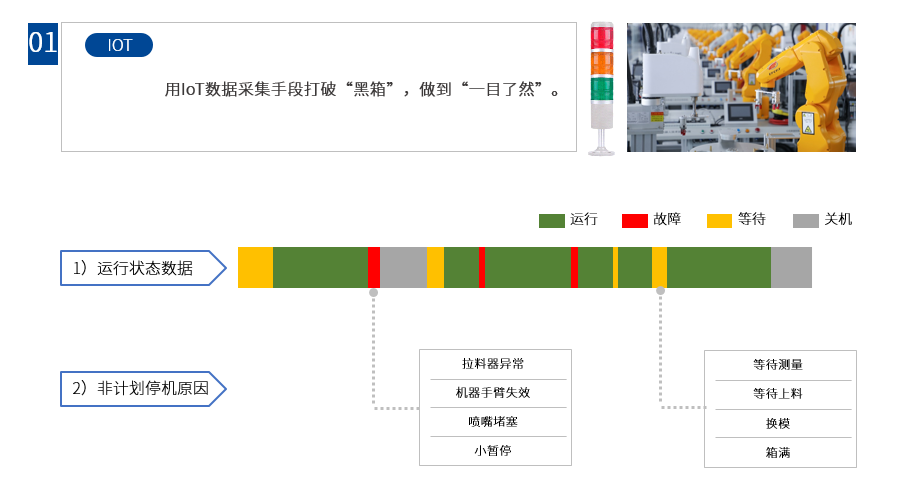
The first step of the three-step process is data collection. So, what data is actually needed to improve OEE? It is not that complicated; just collect data from two levels. First, equipment operating status data—that is, clearly knowing what state the equipment is in and how long it stays in each state. Second, the causes of unscheduled downtime—whether it's a breakdown, mold change, waiting for material, etc. With these two levels of data, we can clearly see the duration of unscheduled downtime and the proportion of each cause.
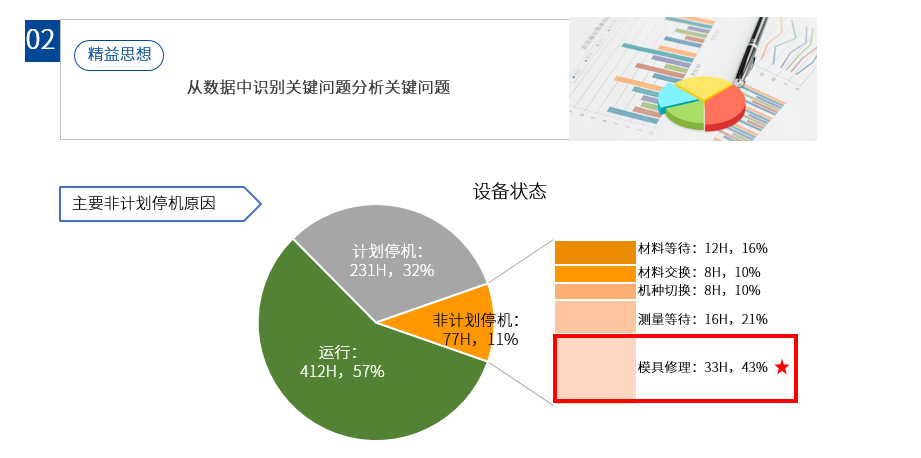
After obtaining the data, we use lean production thinking to identify key problems and implement improvements. Typically, we select the primary cause of downtime for analysis and resolution. In the example shown in the figure, mold repair is the main cause of unscheduled downtime, so we would analyze and improve this issue.
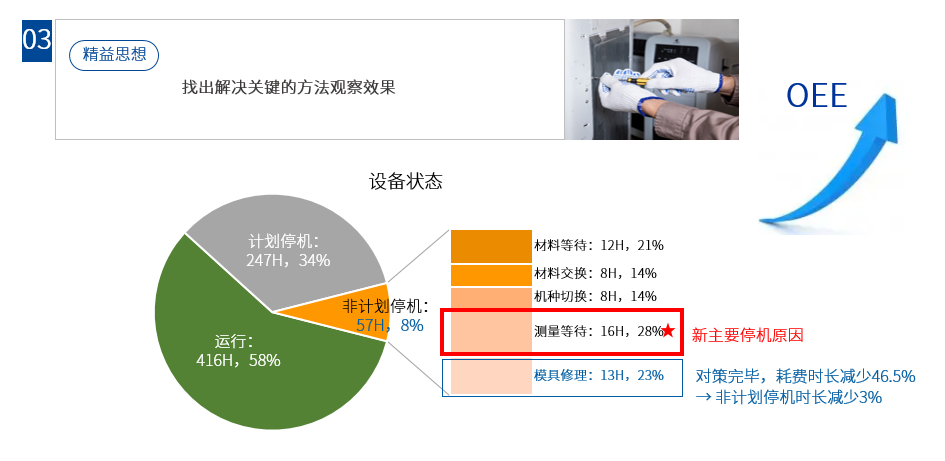
After implementing improvement activities, we evaluate the effect using data. If the improvement is effective, OEE will certainly increase. Then we can start the next improvement cycle. By using data to identify major downtime causes, making improvements, and evaluating results with data, OEE will continuously improve through this repeated three-step process.
The Core of the Three-Step Process: Data Collection
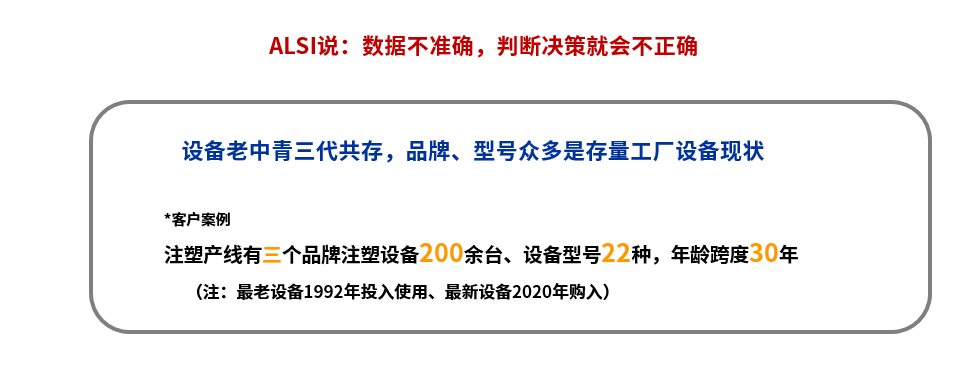
Within this three-step process, the most important aspect is obtaining accurate data. Inaccurate data leads to incorrect judgments and decisions. Most existing factories have a mix of old, middle-aged, and new equipment, with various brands and models—this is a common situation and the biggest obstacle to acquiring accurate data, because most older devices lack external data interfaces.
To solve the data collection problem for older equipment and thereby improve OEE, ALSI has developed a patented universal intelligent data collector, the TS-10, which perfectly addresses the issue of equipment status collection. This product is a collection terminal that attaches externally to the equipment’s three-color signal tower to capture equipment status. It is compatible with any device and can be installed without equipment modification or downtime. The causes of unscheduled downtime are effectively addressed by another flagship ALSI product, the "Quick Key."
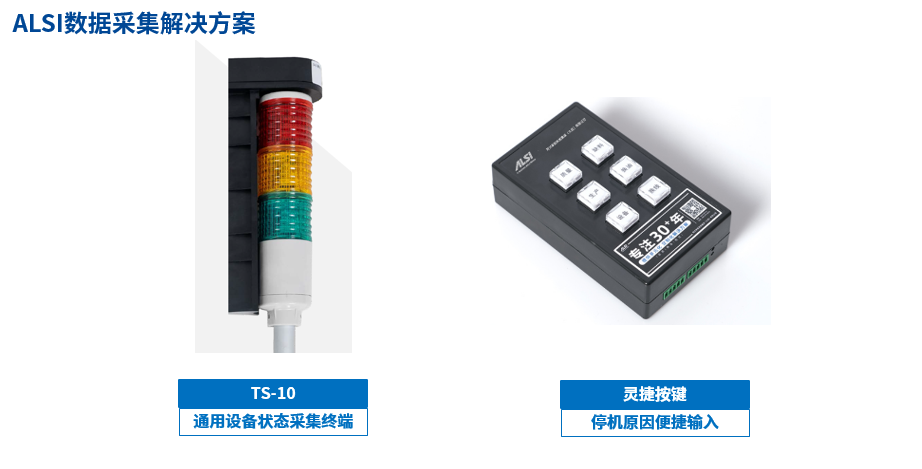
With the TS-10 and Quick Key, the following problems can be solved:
1) Real-time monitoring of equipment operating status and data collection;
2) Gantt chart of equipment operating status;
3) Statistical analysis of unscheduled downtime causes.
This solution provides a low-cost, easy way to capture all equipment status and unscheduled downtime cause data, enabling continuous OEE improvement—even for older equipment.
In this edition of 'Lean Insights,' we have discussed the first key point in automation construction. ALSI will share insights on the remaining two key points in future posts. Follow the official ALSI Intelligent Manufacturing WeChat account to stay tuned for the next part of "Automation ≠ Cost Reduction & Efficiency Enhancement – IoT + Lean + Digitalization Empowering Intelligent Manufacturing Upgrade and Transcendence."