

 Products & Services






 400 676 5650
What is JIT?
Many companies today are implementing Lean, TPS (Toyota Production System), or WCM (World Class Manufacturing). Some people claim their enterprises have achieved JIT. When asked further, they mention a Kanban system, SMED (Single Minute Exchange of Die), and an assembly line with one-piece flow, assuming that this constitutes JIT!
Many people talk about their understanding of JIT, but they cannot articulate it clearly. They casually list tools—what does listing them achieve? Does listing them mean JIT is realized?
Let us first look at the definition of JIT: JIT is the ideal state of production management, where parts are provided in the required quantity, at the required time, and at the required place, with no delays, no waiting, and no excess quantity (Original Japanese text: 必要なものを、必要な分だけ、必要なときに提供しないのか). Taiichi Ohno's discussion of JIT uses automobile production as an example: on an assembly line, a workstation needs parts; at the exact time they are needed, the exact quantity arrives. Just-in-time is a demand-driven, reverse production management arrangement, i.e., a pull system that satisfies downstream needs.
In summary: JIT means that each workstation produces only what the downstream station needs and continuously moves it to the next station. It is easy to understand but also easy to misinterpret.
JIT is highly effective in industrial management. It is a market-oriented production system based on meeting customer demand. JIT is a goal, not a means. Without understanding the practical methods and technologies that form its core, the term JIT itself is meaningless.

JIT ≠ Kanban
When I talk with peers in the industry, some always ask: "Are you referring to the Toyota Kanban system?" I think this shows that the Kanban system is quite famous. However, the Kanban system is only a part of JIT, not the whole. The Kanban system can be considered an information transmission system—one of the techniques used to achieve JIT. After the 1973 oil crisis, Toyota's JIT first attracted public attention when market demand was weak. A trend toward diversified market demands emerged, and Japan's economic growth slowed to a more sluggish pace. In this context, JIT gained fame in the media as a way to sustain profit growth.
The first JIT technique to draw attention was the Kanban system, where information attached to goods replaced paper tickets as the medium for issuing operation and production instructions.
"Just in Time" vs. "In Time"
JIT, or "Just In Time," refers to the timing of the production process: parts are delivered precisely to the process when needed, in the required quantity, to the stations that need them. Saying "in time" is insufficient, because parts could arrive one or two weeks before use and still be "in time." "Just in time" means parts arrive exactly when needed, with no WIP (work in process). "In time" only guarantees that parts are available when needed, possibly with WIP.
The original Japanese text of JIT literally requires: the required time, the required quantity, and delivery to the required place. These are explicit conditions, but there are also implicit conditions: no early delivery, must be good quality, and stable quality.
No early delivery: if parts are delivered when not needed, they must be placed elsewhere, causing double handling and occupying space. Must be good quality: if a batch of defective parts arrives, how can the downstream station produce? The required quantity also becomes problematic. Whether the upstream station reworks or the downstream station reworks, delays occur.
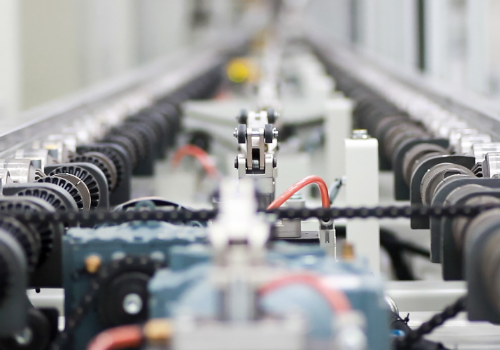
This is why the most important word in JIT is the first one: "Just." Goods need to arrive at the production line within minutes, not within days or weeks. Only then can we eliminate waste in the forms of overproduction, waiting for delayed delivery, and excess inventory.
Let me give an example: beside a stamping press, there is a large pile of pre-cut steel sheets. All those sheets are there "in time" for stamping. They could have been cut yesterday and delivered "in time" next to the press. Or they could have been cut last week or last month and still be "in time." In any case, the sheets arrived "in time," not "just in time."
Flow Production
When the press operator is ready to process a steel sheet, he only needs one sheet from the upstream process, not ten or twenty. After processing that one, he is ready to take another from upstream. This is how WIP moves: one piece at a time from raw material to finished product.
Thinking of JIT as the flow of a river can help understanding. In a river, different workpieces drift horizontally from one station to another as they are sent downstream.
At first glance, JIT seems simple enough, but when we delve deeper into its meaning, we find it is very complex and full of things that cannot be fully understood without implementation in a factory. Factory-based improvement is not about discussion, hearing, or seeing; it is about doing, and that is the core of factory improvement.
The purpose of JIT is to produce in a way that maintains only one unit of WIP and minimal finished goods inventory. Unnecessary inventory is waste. Therefore, only goods that can be sold should be produced. One-piece flow that moves just in time into the next process is an ideal state!
JIT is also described as a system that improves production efficiency and prevents product defects by reducing inventory. It emphasizes the fact that inventory in a factory is undesirable for many reasons, even though it is commonly accepted. Inventory hides imbalances between processes and departments: idle time, overstaffing, understaffing, excess capacity, and insufficient maintenance.

Characteristics of JIT
1. JIT differs significantly from traditional Industrial Engineering (IE) improvement. The latter is usually based on analysis of the current state. Improvement personnel take stopwatches and other instruments to measure current processes, analyze them, and attempt to improve or fix poor conditions. In contrast, JIT is based on an ideal, not the measurement of the current state. The goal is to make the entire factory conform to the JIT system. While traditional IE uses inductive methods based on statistical data, JIT addresses only one problem—just-in-time (JIT) production—and uses a deductive method to improve the factory.
2. Stable quality. Only stable quality ensures that the upstream station delivers good parts. Stable quality requires control of 4M change points, supported by measures such as Poka-yoke and Jidoka. Quality and delivery speed are both reflected in the components; JIT and TQC are two sides of the same coin. JIT must pay attention to quality, and TQC must pay attention to speed.
3. A common misconception is that JIT is an inventory control system. Furthermore, JIT is often equated with kanban, which is the name of the inventory replenishment information system developed by Toyota in Japan. Kanban is undoubtedly an indispensable part of JIT production, but the JIT system refers to all production activities, not just the flow of materials between customers and suppliers.
 Three key points to achieve JIT: system coordination, process layout, and small lot sizes. These three points rely on system control, one-piece flow, and SMED, all interlinked. Failure in any coordination can lead to overproduction or process delays.
Purpose of JIT
The purpose of JIT is to eliminate delays and inventory. There are many factors that cause process delays and inventory; only comprehensive improvement can thoroughly eliminate them.
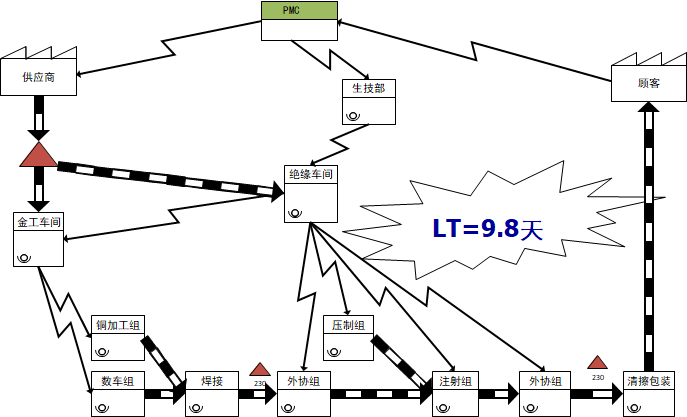
Toyota has a tool to measure JIT level—the Material and Information Flow Chart (Value Stream Map). One cannot help but admire the richness of the Chinese language. "物" (material) here indicates the flow and stagnation of materials. "情报" (intelligence/information) refers to purposeful, time-sensitive, professionally obtained, specific reporting or collated data that involves interests. "信息" (information) refers to messages, news, objects transmitted and processed by communication systems, broadly covering all content disseminated in human society.
Shigeo Shingo (a renowned IE expert who served as an IE consultant for Toyota) described the production process in a unique way: separating the product and the operator, viewing them separately, and then solving them together as a network of processes and operations. This was a revolutionary way of viewing work. Before Shingo's discovery, process and operation were considered on the same axis. For years, we focused only on the operator and tried to improve his work, but we never looked at what the process was doing. One of the biggest opportunities lies in improving the product's flow. If we eliminate a product step, we also eliminate the operation steps attached to it.
XX Product Family Value Stream Map (Current State) ⬇
XX Product Family Value Stream Map (Future State) ⬇
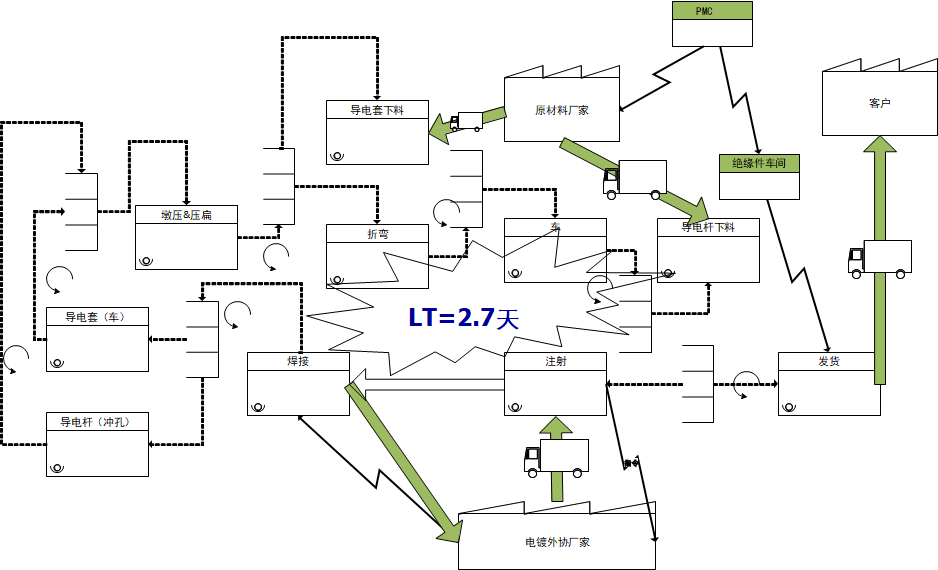
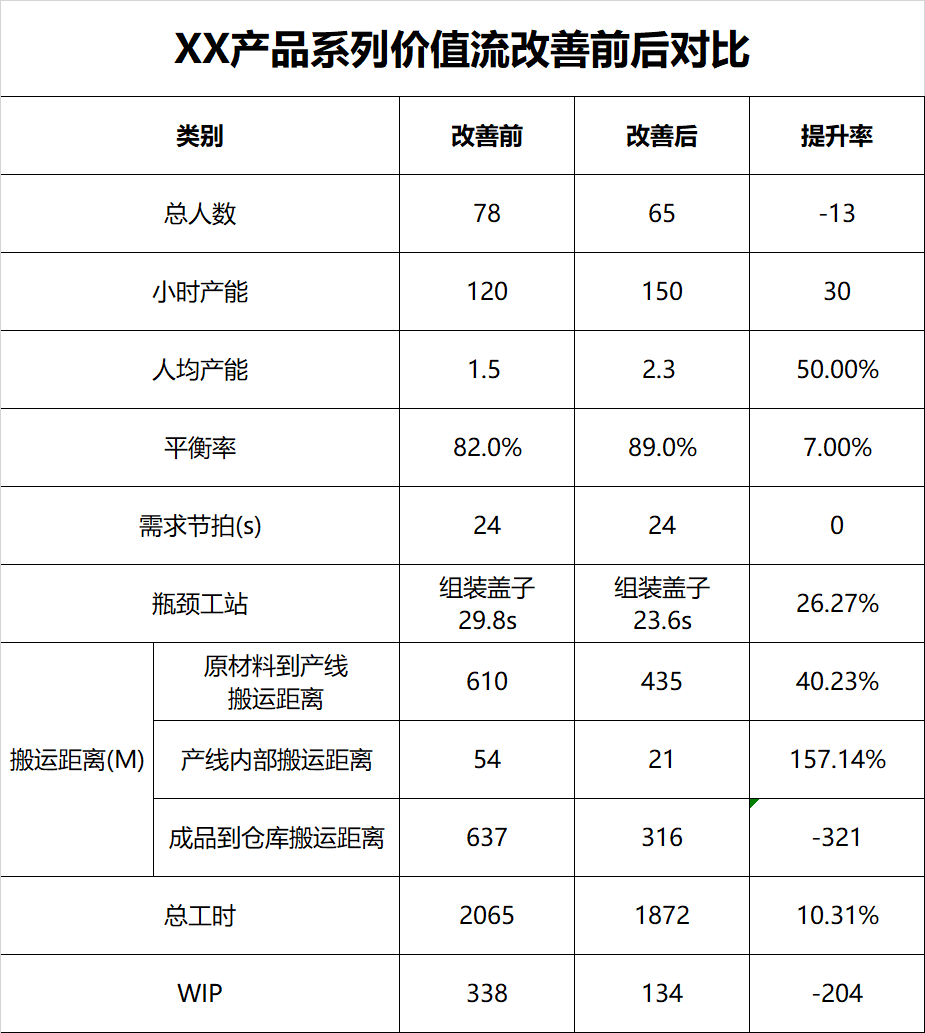
The Material and Information Flow Chart (Value Stream Map) applies Shigeo Shingo's production structure diagram. The process is divided into four stages: processing, inspection, transportation, and storage. According to value-added judgment, only the processing stage is value-added. The processing stage is further divided into four parts: setup operation, basic operation, auxiliary operation, and allowance operation. According to value-added judgment, only the basic operation within processing is value-added.
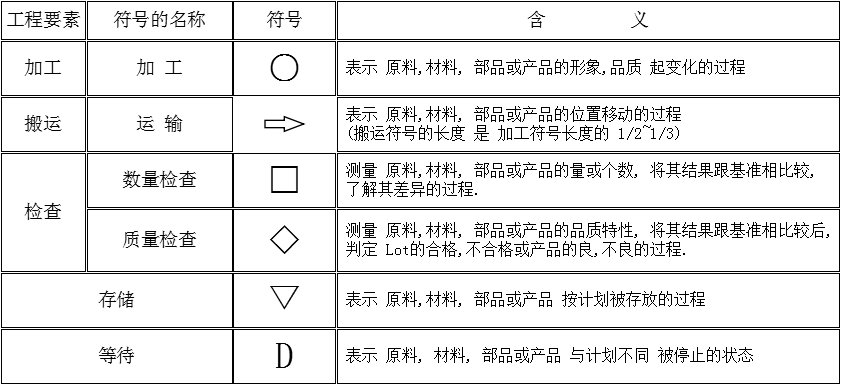
When drawing the Material and Information Flow Chart (Value Stream Map), based on the relationship between process and operation, only the basic operation in the processing stage is value-added. By calculating the proportion of processing time in the entire production flow, the JIT level can be measured.