


 Products & Services







 400 676 5650
Time:2026-03-24
The inventory value in the warehouse climbs month by month, yet several critical parts urgently needed on the production line are always out of stock. The procurement team says all required purchase orders have been placed; the warehouse says materials are entered into inventory upon arrival; the planner says the system showed available stock during scheduling, but when work orders are released to the shop floor, the materials are not yet in place. This contradiction is not uncommon in manufacturing enterprises, often rooted in the misalignment between material receiving time and production demand time. Production Planning and Scheduling Software addresses such issues by adjusting several key links, so that inventory surplus and shortages no longer coexist.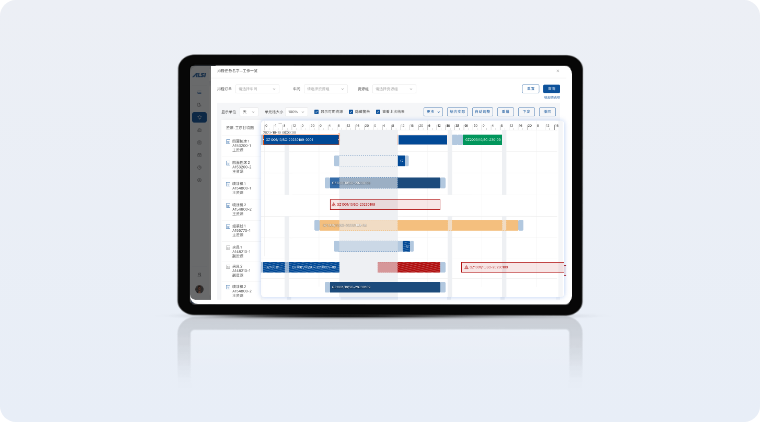
First, Alignment of Material Receipt with Work Order Start Times
Production Planning and Scheduling Software first places material receipt times and work order start times on the same timeline. For each work order, the system backward-calculates the latest required time for each material based on the process route and operation duration. This required time is compared with the expected receipt date from the purchase order. If a material might arrive later than the work order start time, the system marks the order during scheduling and excludes it from the executable schedule. The schedule that planners see daily consists only of tasks whose materials are already kitted or will be kitted soon, rather than a pile of all work orders.
Second, Inclusion of In-Transit Materials in Calculations
Some materials, though not yet received, are already in transit. Production Planning and Scheduling Software estimates their availability based on logistics information and supplier-confirmed delivery dates. During scheduling, these in-transit materials are calculated together with on-hand inventory. The material status that planners see is no longer simply present or absent, but rather how much quantity will arrive at which time. This approach makes the schedule more realistic, preventing work orders from being delayed just because materials haven't been received yet, and also avoiding missed resources by relying solely on on-hand stock.
Third, Accumulation and Application of Supplier Delivery Patterns
After running for a period, Production Planning and Scheduling Software accumulates actual receipt times for each purchase order and the corresponding work order start times. These data can produce statistics on each supplier's delivery patterns and which materials frequently cause production line stoppages. When buyers obtain this data, they have a clearer reference for placing orders. For example, if a supplier's delivery lead time is two days longer than the standard, the software will automatically incorporate this deviation in subsequent scheduling, advancing work order start times or moving purchase order dates earlier. This adjustment is not based on guesswork but on historical data calculated by the system.
Fourth, Dynamic Matching of Substitute Materials
Many factories have substitute materials – when one material is out of stock, another specification can replace it. However, traditional scheduling makes it difficult to find which of hundreds of work orders can use substitutes. Production Planning and Scheduling Software pre-configures substitution relationships. When the primary material is insufficient, it automatically checks if any available substitute exists in stock and allocates it to the work order. This way, a work order that would otherwise be halted due to material shortage can continue production thanks to substitutes. Meanwhile, some accumulated inventory can be consumed rather than sitting in the warehouse.
Fifth, Linking the Time Chain of Inventory and Demand
The phenomenon of high inventory but material shortage often arises because some materials are purchased too early and others too late. Production Planning and Scheduling Software brings these two time points together for comparison, making the deviation clear. Planners no longer see two separate tables but a complete chain from procurement receipt to work order consumption. Once this chain is clarified, the problem of coexisting high inventory and shortages will naturally narrow.
Production Planning and Scheduling Software cannot instantly reduce inventory, but it makes transparent what is in stock and what the production line lacks. Planners and buyers share a common time coordinate, giving them a handle to resolve the contradiction between inventory and shortages. By aligning material receipt times with work order start times, the software reconnects two previously misaligned links. Inventory buildup and production line shortages are no longer two isolated problems but two nodes on the same time chain. Once this chain is straightened, materials flow through the warehouse, and waiting time on the production line is reduced.