

 Products & Services







 400 676 5650
Time:2026-01-22
"Planning" is no longer as simple as lining up orders on the production line. Multi-variety, small-batch production, frequent changes in delivery dates, and highly constrained resources are becoming the norm for more and more manufacturing enterprises. In this context, supply chain planning and scheduling systems are frequently appearing in corporate digital transformation plans. So, what exactly is a supply chain planning and scheduling system? What core problem does it solve? Understanding this clearly is the first step for enterprises to determine whether they need to introduce such a system.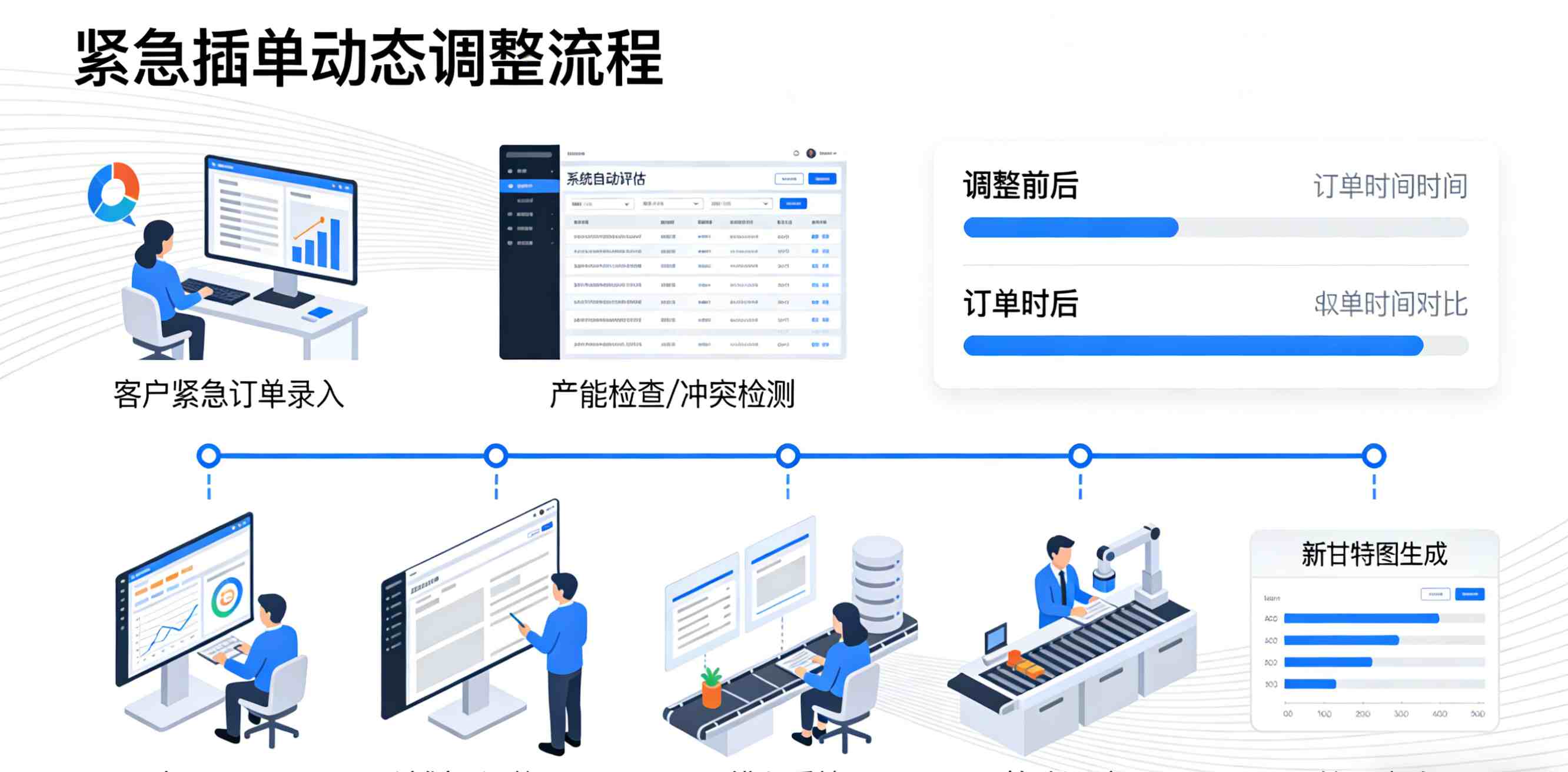
I. Definition and Positioning: From "Scheduling Tool" to "Decision System"
A supply chain planning and scheduling system is a specialized planning decision system designed for complex manufacturing scenarios. Unlike traditional experience-based scheduling methods that rely on static plans, it is grounded in supply chain management principles and constraint theory. It unifies multi-dimensional information within an enterprise—such as order demand, production resources, process flows, and material supply—into a single model. Through computation and optimization, it generates a production plan and schedule that is truly "executable" under real-world conditions. It is not a simple scheduling tool but a system capability that helps enterprises make better production decisions.
II. System Logic: Modeling and Optimization Based on Real Constraints
From a system logic perspective, a supply chain planning and scheduling system does not produce results out of thin air; instead, it first creates a high-fidelity representation of the enterprise's actual operating state. Based on key factors such as equipment capacity, personnel shifts, process routes, and material availability, the system builds a mathematical model that reflects the enterprise's reality. On this basis, the supply chain planning and scheduling system introduces intelligent algorithms to perform global computation and optimization of production processes and resource allocation. Especially in situations where order delivery dates are tight and resource conflicts are frequent, the system can balance delivery, efficiency, and cost under limited resource constraints, outputting a more reasonable scheduling result.
III. Core Advantage: Ability to Handle Complex Constraints Dynamically
Compared to traditional ERP or MRP systems, the biggest difference of a supply chain planning and scheduling system lies in its ability to handle complex constraints and dynamic changes. The system is specifically designed to address these challenges. It not only considers "whether to produce" but also answers "when to produce, on which equipment to produce, and in what sequence," and can quickly recalculate when the environment changes, helping enterprises maintain both plan stability and flexibility.
IV. Application Value: From Efficiency Improvement to Decision Support
From an application value perspective, the significance of a supply chain planning and scheduling system goes beyond improving scheduling efficiency. Through continuous optimization of the production process, enterprises can more clearly identify bottleneck resources, predict delivery risks in advance, and reduce ineffective waiting and plan disruption caused by frequent rush orders. At the same time, the system helps management evaluate the impact of different production strategies from a global perspective, providing data support for capacity planning, order acceptance, and supply chain collaboration. This shift from an "execution tool" to a "decision support system" is precisely the important role that supply chain planning and scheduling systems play in the digital transformation of manufacturing.
V. Key to Implementation: Data Accuracy and Business Alignment
It is important to emphasize that a supply chain planning and scheduling system is not a "plug-and-play" universal software. Its value heavily depends on the accuracy of the enterprise's foundational data and the clarity of its business rules. However, once the system model closely aligns with actual production, the supply chain planning and scheduling system brings not only improved scheduling efficiency but also an upgrade in production management methods.
Supply chain planning and scheduling systems are advanced planning and scheduling tools that focus on constraints and aim for optimization. Through powerful computational capabilities and intelligent algorithms, they transform complex production problems into decision processes that can be analyzed, simulated, and optimized. This helps manufacturing enterprises achieve efficient resource utilization and continuous production optimization in an increasingly uncertain environment. This is the irreplaceable core value of supply chain planning and scheduling systems in today's manufacturing industry.